
October 8, 2026
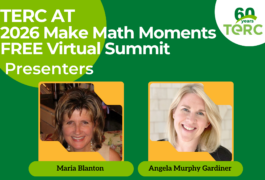
Join TERC’s Maria Blanton & Angela Murphy Gardiner on Nov 14th as they share Project LEAP’s research-based approach — with video of real elementary students doing this work and the evidence of what they learned.
October 2, 2026
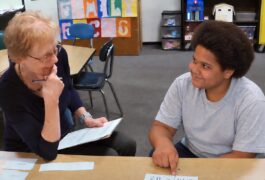
TERC and the Maine Mathematics & Science Alliance (MMSA) are recruiting educators to participate in Learning from Student Thinking, a new project focused on learning from the mathematical thinking of neurodivergent students in grades 3–5.
September 30, 2026
TERC researchers Anushree Bopardikar and Christina B. Silva have co-authored a new article in the Fall 2026 issue of the NCSM Journal of Mathematics Education Leadership. The study explores how structured professional development protocols and video-analysis tools support math coaches in guiding teachers to foster mathematical argumentation. Ultimately, the research offers critical recommendations for designing flexible coaching routines that ensure every student can actively participate in rich mathematical discourse.
September 25, 2026
Teresa Lara-Meloy, and Ken Rafanan, with Elise Levin-Güracar of UC Berkeley, examine what minoritized youth learn through making in community-based makerspaces and afterschool programs. Their new paper, Life Is Your Block of Clay.” Applying a Typology for Learning in Makerspaces, explores how a framework for identifying learning can help make that often-implicit learning more visible.

September 25, 2026
A new article co-authored by TERC’s Andee Rubin explores how a translanguaging lens can reveal the complex ways emergent bilingual students make meaning in mathematics. The research shows how students blend language, gestures, interactions, and technology as they work together to engage in mathematical modeling.