
October 10, 2017
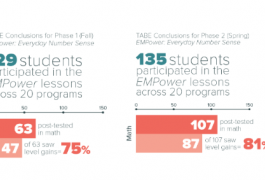
Adult Education Students Gain Conceptual Understanding and Real-World Math Skills
Overview
Kentucky Adult Education (KYAE) Skills U helps adult students attain high school equivalency diplomas and prepare for college and career success.
Gayle Box, Senior Associate of College and Career Preparation, has worked for a decade to ensure adult students reach their goals. With KYAE Skills U’s adoption of the College and Career Readiness Standards (CCRS) from the Office of Career, Technical and Adult Education (OCTAE) in 2012, » Read more
October 3, 2017
Register for Andee Rubin’s talk at BostonCHI’s monthly meeting, Expressive Representational Tools for Elementary Math Students. October 10 at 6:30pm
September 21, 2017
Jodi Asbell-Clarke to give a keynote address at the ECR PI Convening, Monday, September 25, 2017. We Know More Than We Can Tell: Differentiated Learning through Implicit Assessment
September 20, 2017
By Andee Rubin, Scott Pattison, and Tracey Wright— 2017. Dimensions, Vol 18, No. 6. Association of Science-Technology Centers Incorporated, Washington, DC.
Negative attitudes about mathematics and the poor performance of U.S. adults and students on measures of mathematical reasoning are well-documented problems that limit many people’s identities and career aspirations. At the same time, the last decade has seen a proliferation of out-of-school environments that foster making and tinkering activities. Enthusiastic participants in these activities are often engaging in mathematical reasoning without realizing it—and thus do not consider themselves competent mathematical thinkers. » Read more
September 12, 2017
How to be a STEM Mentor interactive workshop, presented by Moms as Mentors, October 11, 2017, 6:30pm-8:00pm.