Afterschool Making Projects with Design Thinking and Mathematics with Latinx Communities (AMPED 4 Making)
Lead Staff:
Teresa Lara-MeloyNuria Jaumot-Pascual
Project Staff:
Ken RafananSantiago Gasca
Other Project Staff Leaders
Jennifer Knudsen, TERC Alum
Celia García Alvarado, Cesar Chavez Foundation
Team Members
Elise Levin-Guracar, TERC Alum
Rachel Hayes, TERC Alum
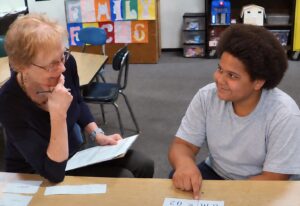
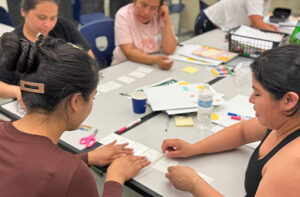
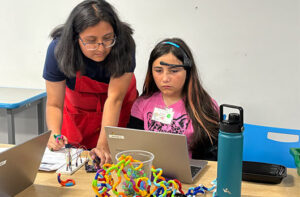
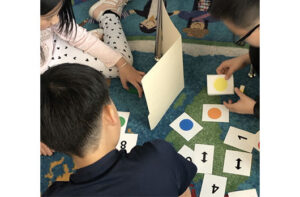
Project SummaryAMPD4MATH was the flagship project of a partnership between TERC and the Cesar Chavez Foundation (CCF) Education Fund. Middle school youth engaged in design-and-making projects that addressed community goals. The project aimed to change youth’s relationship with mathematics by providing opportunities to do important mathematics while drawing on community and cultural strengths, particularly community mathematical know-how. The project used a co-design framework to develop an equity-focused making program. AMPD4MATH relied on the life and values of Cesar Chavez as a touchstone for rural Latinx youth’s positive identity.
AMPD4Math engaged Latinx youth who live in the agricultural regions of the Southwest United States to develop their
- agency and positive identity, as makers, mathematical doers and users, and community members
- understanding of grade-appropriate mathematics, such as the volume and surface area of geometric shapes, within the context of informal learning projects.
- perceptions of how they can use mathematics, design, and making in their future lives and work.
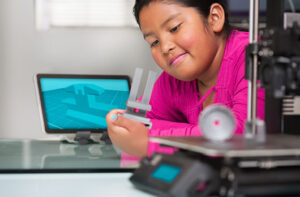
Research ActivityThis was a design and development project. The project co-designed the program with two afterschool programs in the first year of the program. In years 2 and 3, the project trained afterschool facilitators and collected data on the program’s effectiveness.
ImpactAMPD4MATH provided Latinx youth with access to these tools and brought greater opportunities to engage in STEM work.
Conference Presentations
AMPED 4 Making staff presented at the 2025 END International Conference. The conference offered a worldwide connection between teachers, students, researchers, and lecturers, from a wide range of academic fields, interested in exploring and giving their contribution to educational issues.
Sessions from Ken Rafanan, Nuria Jaumot-Pascual, Teresa Lara-Meloy, Jennifer Knudsen, and Elise Levin-Güracar included:
-
- TEAR-FREE MATH ASSESSMENT FOR INFORMAL LEARNING RESEARCH
Teresa Lara-Meloy, Ken Rafanan, & Elise Levin-Güracar
-
- MATH AND MAKING IN AFTERSCHOOL – A PEDAGOGIC INNOVATION WITH LATINX MIDDLE SCHOOL YOUTH
Nuria Jaumot-Pascual, Teresa Lara-Meloy, & Ken Rafanan
-
- MATH AND MAKING FOR MIDDLE SCHOOL YOUTH: A LONGITUDINAL SINGLE-CASE STUDY
Elise Levin-Güracar, Nuria Jaumot-Pascual, Teresa Lara-Meloy, & Jad Eways
-
- “I FINALLY FIGURED OUT HOW TO DO IT!” MATH AND MAKER IDENTITY DEVELOPMENT
Nuria Jaumot-Pascual, Jennifer Knudsen, Elise Levin-Güracar, & Sarah Grams
Leaders
Jennifer Knudsen, TERC Alum
Celia García Alvarado, Cesar Chavez Foundation
Team Members
Elise Levin-Guracar, TERC Alum
Rachel Hayes, TERC Alum
AMPD4Math engaged Latinx youth who live in the agricultural regions of the Southwest United States to develop their
- agency and positive identity, as makers, mathematical doers and users, and community members
- understanding of grade-appropriate mathematics, such as the volume and surface area of geometric shapes, within the context of informal learning projects.
- perceptions of how they can use mathematics, design, and making in their future lives and work.
Research ActivityThis was a design and development project. The project co-designed the program with two afterschool programs in the first year of the program. In years 2 and 3, the project trained afterschool facilitators and collected data on the program’s effectiveness.
ImpactAMPD4MATH provided Latinx youth with access to these tools and brought greater opportunities to engage in STEM work.
Conference Presentations
AMPED 4 Making staff presented at the 2025 END International Conference. The conference offered a worldwide connection between teachers, students, researchers, and lecturers, from a wide range of academic fields, interested in exploring and giving their contribution to educational issues.
Sessions from Ken Rafanan, Nuria Jaumot-Pascual, Teresa Lara-Meloy, Jennifer Knudsen, and Elise Levin-Güracar included:
-
- TEAR-FREE MATH ASSESSMENT FOR INFORMAL LEARNING RESEARCH
Teresa Lara-Meloy, Ken Rafanan, & Elise Levin-Güracar
-
- MATH AND MAKING IN AFTERSCHOOL – A PEDAGOGIC INNOVATION WITH LATINX MIDDLE SCHOOL YOUTH
Nuria Jaumot-Pascual, Teresa Lara-Meloy, & Ken Rafanan
-
- MATH AND MAKING FOR MIDDLE SCHOOL YOUTH: A LONGITUDINAL SINGLE-CASE STUDY
Elise Levin-Güracar, Nuria Jaumot-Pascual, Teresa Lara-Meloy, & Jad Eways
-
- “I FINALLY FIGURED OUT HOW TO DO IT!” MATH AND MAKER IDENTITY DEVELOPMENT
Nuria Jaumot-Pascual, Jennifer Knudsen, Elise Levin-Güracar, & Sarah Grams
This was a design and development project. The project co-designed the program with two afterschool programs in the first year of the program. In years 2 and 3, the project trained afterschool facilitators and collected data on the program’s effectiveness.
AMPD4MATH provided Latinx youth with access to these tools and brought greater opportunities to engage in STEM work.
Conference Presentations
AMPED 4 Making staff presented at the 2025 END International Conference. The conference offered a worldwide connection between teachers, students, researchers, and lecturers, from a wide range of academic fields, interested in exploring and giving their contribution to educational issues.
Sessions from Ken Rafanan, Nuria Jaumot-Pascual, Teresa Lara-Meloy, Jennifer Knudsen, and Elise Levin-Güracar included:
-
- TEAR-FREE MATH ASSESSMENT FOR INFORMAL LEARNING RESEARCH
Teresa Lara-Meloy, Ken Rafanan, & Elise Levin-Güracar
-
- MATH AND MAKING IN AFTERSCHOOL – A PEDAGOGIC INNOVATION WITH LATINX MIDDLE SCHOOL YOUTH
Nuria Jaumot-Pascual, Teresa Lara-Meloy, & Ken Rafanan
-
- MATH AND MAKING FOR MIDDLE SCHOOL YOUTH: A LONGITUDINAL SINGLE-CASE STUDY
Elise Levin-Güracar, Nuria Jaumot-Pascual, Teresa Lara-Meloy, & Jad Eways
-
- “I FINALLY FIGURED OUT HOW TO DO IT!” MATH AND MAKER IDENTITY DEVELOPMENT
Nuria Jaumot-Pascual, Jennifer Knudsen, Elise Levin-Güracar, & Sarah Grams
AMPED 4 Making staff presented at the 2025 END International Conference. The conference offered a worldwide connection between teachers, students, researchers, and lecturers, from a wide range of academic fields, interested in exploring and giving their contribution to educational issues.
Sessions from Ken Rafanan, Nuria Jaumot-Pascual, Teresa Lara-Meloy, Jennifer Knudsen, and Elise Levin-Güracar included:
-
- TEAR-FREE MATH ASSESSMENT FOR INFORMAL LEARNING RESEARCH
Teresa Lara-Meloy, Ken Rafanan, & Elise Levin-Güracar
- TEAR-FREE MATH ASSESSMENT FOR INFORMAL LEARNING RESEARCH
-
- MATH AND MAKING IN AFTERSCHOOL – A PEDAGOGIC INNOVATION WITH LATINX MIDDLE SCHOOL YOUTH
Nuria Jaumot-Pascual, Teresa Lara-Meloy, & Ken Rafanan
- MATH AND MAKING IN AFTERSCHOOL – A PEDAGOGIC INNOVATION WITH LATINX MIDDLE SCHOOL YOUTH
-
- MATH AND MAKING FOR MIDDLE SCHOOL YOUTH: A LONGITUDINAL SINGLE-CASE STUDY
Elise Levin-Güracar, Nuria Jaumot-Pascual, Teresa Lara-Meloy, & Jad Eways
- MATH AND MAKING FOR MIDDLE SCHOOL YOUTH: A LONGITUDINAL SINGLE-CASE STUDY
-
- “I FINALLY FIGURED OUT HOW TO DO IT!” MATH AND MAKER IDENTITY DEVELOPMENT
Nuria Jaumot-Pascual, Jennifer Knudsen, Elise Levin-Güracar, & Sarah Grams
- “I FINALLY FIGURED OUT HOW TO DO IT!” MATH AND MAKER IDENTITY DEVELOPMENT

 Math
Math Out of School / Informal Education
 Professional Development
 Technology
Funder:
U.S. National Science Foundation
Award Number:
2215382
Dates:
8/01/2022 – 7/31/2026
Past ProjectThis project is no longer active. To see a list of current TERC projects, please click here.
Share This Page: