STEM Signing for Undergraduate Interpreters
Developing a prototype Signing Bioscience Dictionary and researching its effectiveness as a tool to increase the ability of students in interpreter training programs to sign STEM content.
Lead Staff:
Judy VeselCollaboratorDiane Clark, Co-Principal Investigator (Lamar University)
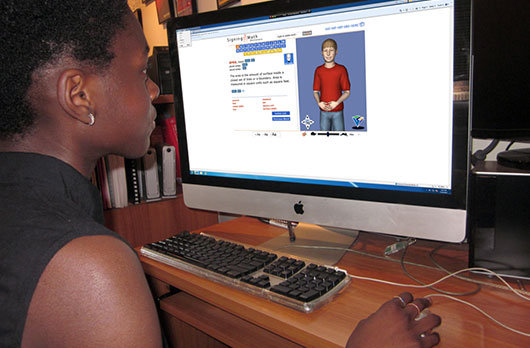
SummaryEducators are persistently challenged with how to broaden participation of underrepresented populations in STEM careers. Historically, students who are deaf or hard of hearing experience significant obstacles to successful learning in the sciences. Most of these students rely on the support of sign language interpreters. This project developed a prototype Signing Bioscience Dictionary that included approximately 1,500 terms routinely used in undergraduate biology courses. The dictionary’s potential effectiveness to increase interpreters’ life science vocabulary has been tested in Lamar University’s four-year undergraduate Interpreter Training Program. The dictionary consists of interactive on-demand videos that include terms, definitions, illustrations, and an Avatar signing the English text-based elements. Use of video makes the dictionary compatible with most computers and browsers and does not require an Internet connection. The overall goal was for trained interpreters to accurately and effectively convey undergraduate biology information via sign language to support deaf and hard of hearing students.
Research ActivityResearch methods and measurements builds on the designs TERC has used for evaluations of other signing dictionaries.
ImpactResults have rendered new knowledge about the effectiveness of the dictionary in strengthening the American Sign Language STEM knowledge of students in Lamar’s training program. The project helps address the challenge of broadening participation of an underrepresented student population in STEM learning and potentially in STEM careers. This project also has lead to the dictionary being incorporated into undergraduate training programs across the nation, potentially increasing the number of STEM interpreters working with these students and leading to more persons who are deaf or hard of hearing pursuing careers in STEM.
Diane Clark, Co-Principal Investigator (Lamar University)
Educators are persistently challenged with how to broaden participation of underrepresented populations in STEM careers. Historically, students who are deaf or hard of hearing experience significant obstacles to successful learning in the sciences. Most of these students rely on the support of sign language interpreters. This project developed a prototype Signing Bioscience Dictionary that included approximately 1,500 terms routinely used in undergraduate biology courses. The dictionary’s potential effectiveness to increase interpreters’ life science vocabulary has been tested in Lamar University’s four-year undergraduate Interpreter Training Program. The dictionary consists of interactive on-demand videos that include terms, definitions, illustrations, and an Avatar signing the English text-based elements. Use of video makes the dictionary compatible with most computers and browsers and does not require an Internet connection. The overall goal was for trained interpreters to accurately and effectively convey undergraduate biology information via sign language to support deaf and hard of hearing students.
Research ActivityResearch methods and measurements builds on the designs TERC has used for evaluations of other signing dictionaries.
ImpactResults have rendered new knowledge about the effectiveness of the dictionary in strengthening the American Sign Language STEM knowledge of students in Lamar’s training program. The project helps address the challenge of broadening participation of an underrepresented student population in STEM learning and potentially in STEM careers. This project also has lead to the dictionary being incorporated into undergraduate training programs across the nation, potentially increasing the number of STEM interpreters working with these students and leading to more persons who are deaf or hard of hearing pursuing careers in STEM.
Research methods and measurements builds on the designs TERC has used for evaluations of other signing dictionaries.
Results have rendered new knowledge about the effectiveness of the dictionary in strengthening the American Sign Language STEM knowledge of students in Lamar’s training program. The project helps address the challenge of broadening participation of an underrepresented student population in STEM learning and potentially in STEM careers. This project also has lead to the dictionary being incorporated into undergraduate training programs across the nation, potentially increasing the number of STEM interpreters working with these students and leading to more persons who are deaf or hard of hearing pursuing careers in STEM.
 Science
Funder:
U.S. National Science Foundation
Award Number:
1703343
Dates:
9/2017 – 7/2023
Share This Page: