
TERC Researchers to Present at the ISLS 2026 Annual Meeting
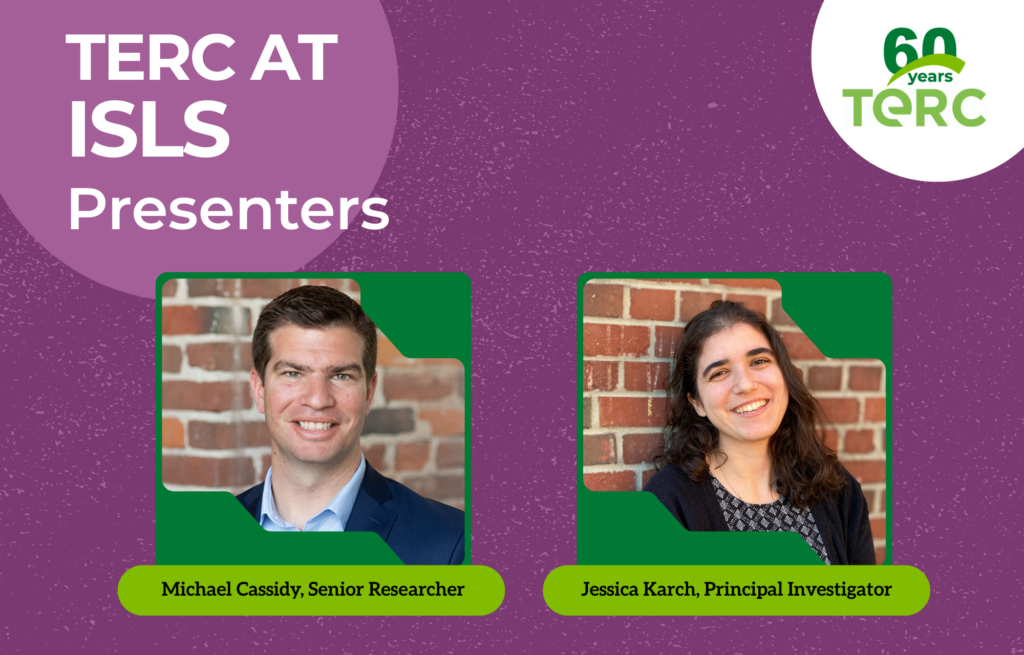
TERC researchers, Jessica Karch and Michael Cassidy will present at the ISLS 2026 Annual Meeting. Their presentations focus on stakeholder collaboration in STEM graduate education and the integration of computational thinking into middle school science through teacher-designed robotics units.
Wednesday, June 17th at 4:15 PM – 5:45 PM PDT
Presentation Title: Work in Progress: Training STEM Graduate Students to Collaborate with Stakeholders to Address Socio-scientific Issues
Presenters: Jessica Karch and Christina Silva
Summary: Socio-scientific issues (SSIs) are complex, real-world problems that arise at the intersection of science and society. SSIs cannot be solved by one discipline alone and should engage stakeholders as part of the problem-solving process. As STEM graduate students are prepared to be scientists and address SSIs, it is imperative that they are trained to collaborate with stakeholders. This scoping review examines how STEM graduate students are trained to collaborate with stakeholders to address SSIs.
Thursday, June 18th at 2:30 PM – 4:00 PM PDT
Presentation Title: Teacher as Designers: Using Robotics to Integrate Computational Thinking and Science
Presenters: Michael Cassidy
Summary: This study examines how middle school science teachers designed and implemented robotics-based units that integrated computational thinking (CT) practices following a professional development (PD) program positioning them as curriculum designers. Drawing on Waterman et al.’s (2020) and Coenraad et al.’s (2022) integration frameworks and the project’s CT framework (Bernstein et al., 2025), we analyzed teacher interviews, implementation logs, lesson plans, and student materials from six teachers across twelve units. Findings show that teachers implemented CT at multiple integration levels, engaging students in algorithm design, decomposition, abstraction, pattern recognition, and data practices. Teachers explored CT practices to establish foundational understanding, enhanced CT–science connections through scaffolds, and guided students to exhibit disciplinary ideas through programmable models and extend understanding by collecting and analyzing data. These findings illustrate how positioning teachers as informed designers supports CT-integrated science curricula.