Viviendo Matemáticas
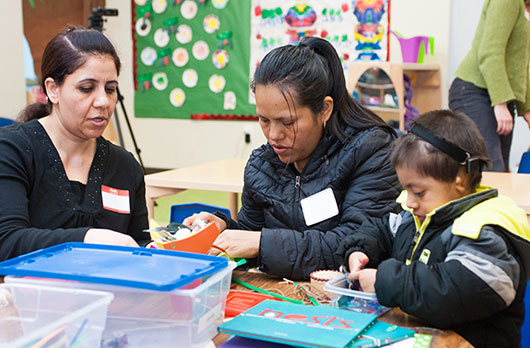
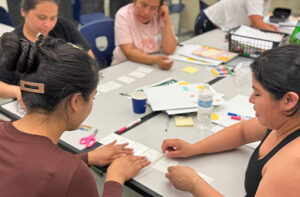
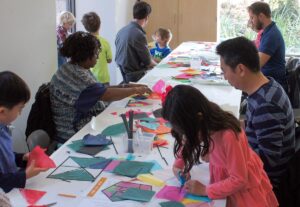
Viviendo Matemáticas is a family–educator partnership program designed to support young children’s mathematical learning by bringing together Head Start educators and Spanish-speaking caregivers. The program follows a dialogic model that centers the voices, experiences, and knowledge of both educators and families, recognizing that everyone contributes valuable insight into how children learn.
GoalsViviendo Matemáticas aims to:
- Build strong personal connections among educators and caregivers
- Support a multilingual learning ecology
- Support power sharing between educators and caregivers
- Expand participants’ ideas about early childhood mathematics
- Create a space where the math-related knowledge and experiences of all participants are included and valued
Proven ImpactFindings from 2 years of pilot research shows the program is highly engaging, broadens participants’ ideas about mathematics, and creates stronger connections between teachers and caregivers. The project also provided new insights into approaches for supporting more equitable relationships between schools and families and for elevating the existing mathematical knowledge within communities.
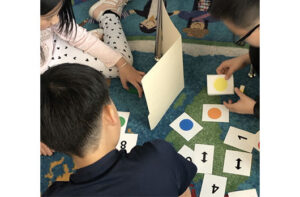
Free Activity GuidesThe program also produced a set of bilingual (Spanish/English) activity guides that can be freely downloaded and used by educators and families. These guides are based on the hands-on math activities used during the program meetings and include simple materials and ideas that support children’s early math learning.
For example, making bracelets with beads helps children explore early math concepts such as counting, measuring, patterns, and symmetry. Creating something special for a loved one also makes learning meaningful and enjoyable for young children.
Viviendo Matemáticas is a family–educator partnership program designed to support young children’s mathematical learning by bringing together Head Start educators and Spanish-speaking caregivers. The program follows a dialogic model that centers the voices, experiences, and knowledge of both educators and families, recognizing that everyone contributes valuable insight into how children learn.
Viviendo Matemáticas aims to:
- Build strong personal connections among educators and caregivers
- Support a multilingual learning ecology
- Support power sharing between educators and caregivers
- Expand participants’ ideas about early childhood mathematics
- Create a space where the math-related knowledge and experiences of all participants are included and valued
Proven ImpactFindings from 2 years of pilot research shows the program is highly engaging, broadens participants’ ideas about mathematics, and creates stronger connections between teachers and caregivers. The project also provided new insights into approaches for supporting more equitable relationships between schools and families and for elevating the existing mathematical knowledge within communities.
Free Activity GuidesThe program also produced a set of bilingual (Spanish/English) activity guides that can be freely downloaded and used by educators and families. These guides are based on the hands-on math activities used during the program meetings and include simple materials and ideas that support children’s early math learning.
For example, making bracelets with beads helps children explore early math concepts such as counting, measuring, patterns, and symmetry. Creating something special for a loved one also makes learning meaningful and enjoyable for young children.
Findings from 2 years of pilot research shows the program is highly engaging, broadens participants’ ideas about mathematics, and creates stronger connections between teachers and caregivers. The project also provided new insights into approaches for supporting more equitable relationships between schools and families and for elevating the existing mathematical knowledge within communities.
The program also produced a set of bilingual (Spanish/English) activity guides that can be freely downloaded and used by educators and families. These guides are based on the hands-on math activities used during the program meetings and include simple materials and ideas that support children’s early math learning.
For example, making bracelets with beads helps children explore early math concepts such as counting, measuring, patterns, and symmetry. Creating something special for a loved one also makes learning meaningful and enjoyable for young children.

Content Areas:
 Math
Math Research / Evaluation
Project TeamMathResearch / EvaluationScott Pattison, Co-Director
Smirla Ramos Montañez, Co-Director
Viviana López Burgos, Bilingual Research Assistant