
“A Little Tornado:” A Teacher Analyzes a Small Group Interaction in Math
by Cinthia Colón
September 3, 2026
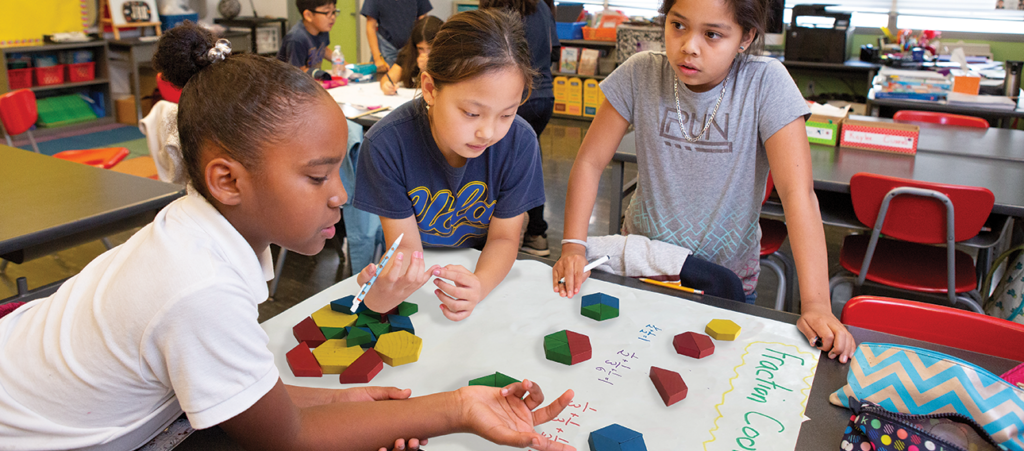
“I wanted to see what they were doing in small groups, to observe how they interact naturally. I was really interested in how each student participates and whether everyone is actually engaged in the work, not just in showing the answer.” – Caroline, Grade 5 Teacher
At the start of the year, teachers set out to create equitable classrooms where students help shape community agreements, practice being active listeners, describe the attributes of a “good” partner, take ownership of their learning, and honor each other’s ideas. During whole-group discussions, it’s easier to see these agreements in action. But ensuring that every student is participating and demonstrating these habits in small groups or pair work can be a real challenge.
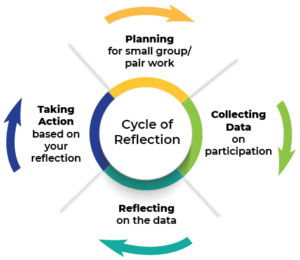
As part of our work to support equitable participation in mathematics classrooms, we collaborated with teachers to develop and field test a Teacher Reflection Tool for Small Group and Pair Work. The tool guides teachers through a four-step cycle: planning how to group students, collecting data on interactions, reflecting on participation patterns, and taking action to improve practice. This cycle gives teachers insight into students’ interactions, revealing patterns that either support or limit equitable participation.
A Teacher Reflects on a “Tornado” of Interaction
During a recent math lesson, Caroline decided to use the Teacher Reflection Tool to take a closer look at a specific triad in her classroom. She set up her computer to record the group and dimmed the screen so students would interact naturally.
The group she chose had a complex dynamic: one student who tends to rush, one who often shuts down, and one who moves more slowly and methodically. After watching the recording, Caroline noticed:
The kid who moves fast as lightning immediately had the marker, and was putting stuff up. The kid who shuts down quickly was saying, “Oh yeah, I see that. I love that.” The two of them were speaking to each other in what felt like a code, just phrases, very quick, and not explanatory. The student who moves slower stood there looking at the board and said, “Wait, I’m confused.” Now that’s a moment I love, because we’ve talked about self-advocating. But the other two were like a little tornado, furiously solving this problem and they didn’t listen to him until they finished their work. Then they said, “Oh, let us explain it to you now.”
Caroline noted that while two students were caught in a “little tornado” of activity, the third was left behind. Even when he self-advocated, stating he was confused, he wasn’t engaged in the problem-solving process until the other two finished their work.
The most profound insight for Caroline was that the students believed they were working together.
Watching that back, I thought, “This is really interesting” because they think they worked together as a group. Even the person who had it explained to him thinks that they were working together, even though he wasn’t actually engaged in the process.
In their minds, “working as a group” meant completing the problem and then explaining it to the person who didn’t understand. They were confusing “giving an answer” or “telling what they did” with genuine collaboration and helping a peer make sense of the math in real time.
Caroline realized that while her class had a strong collaborative culture, the nuances of group dynamics like who participates, how students support one another, and whether all voices are truly heard, wasn’t always visible without careful observation.
Moving from Observation to Action
This reflection prompted Caroline to rethink how she was supporting students to work together in small groups. While she had “talking questions” posted in the room such as How did you get that?, Where did this come from? and Can you show me a representation?, she realized that she didn’t yet have prompts that explicitly addressed group dynamics, engagement, and how students support one another’s understanding.
Caroline took action by intentionally bringing her students into the process. Rather than prescribing solutions, she invited them to reflect on their own collaborative experiences and brainstorm ideas together.
My first step was for them to generate sentence stems to engage all the members of a group. I asked open-ended questions like, “What would you do if you wanted someone to participate with you?” and charted what they said. And they had such great ways to say it that I said, “I don’t need to change any of this, I’m just going to write these up for you. I’m really excited for how positive you are about wanting to involve everybody.”
As a class, they developed sentence stems designed to invite thinking, clarify confusion, and engage all group members more equitably.
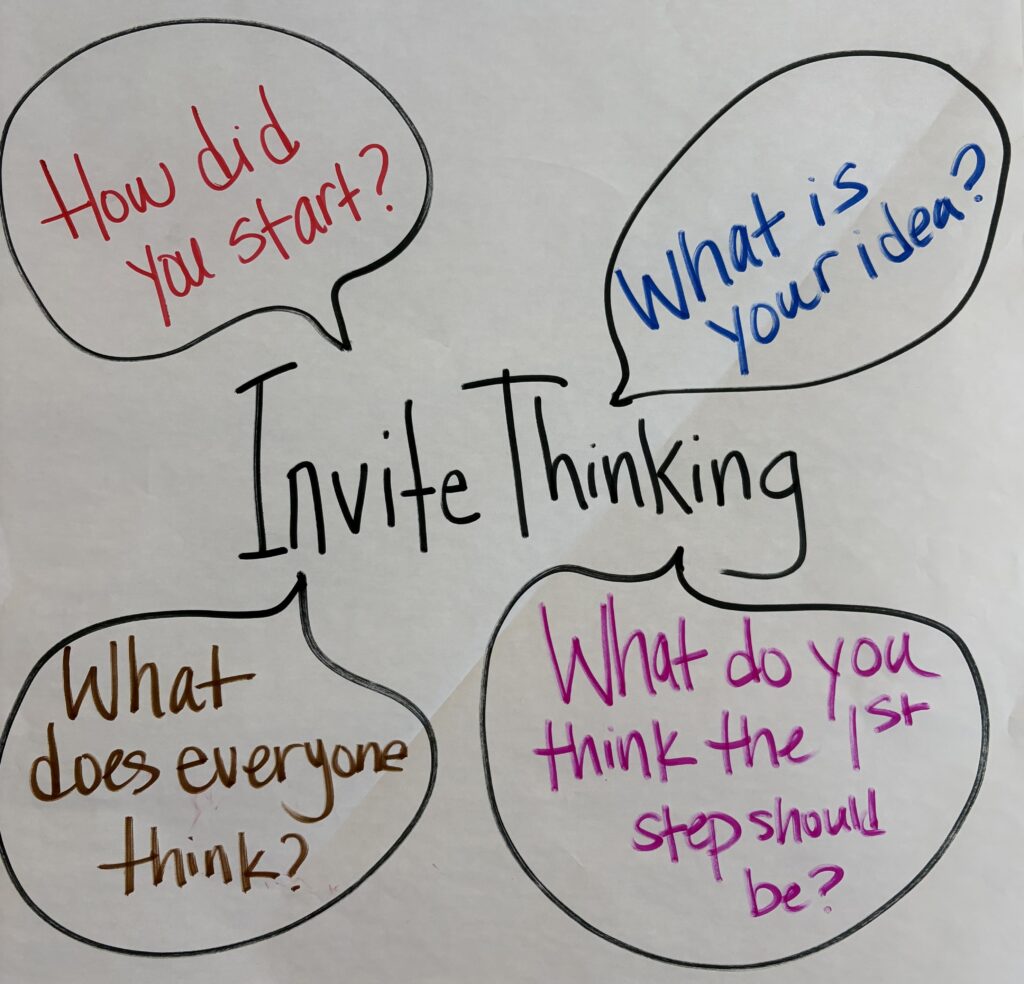
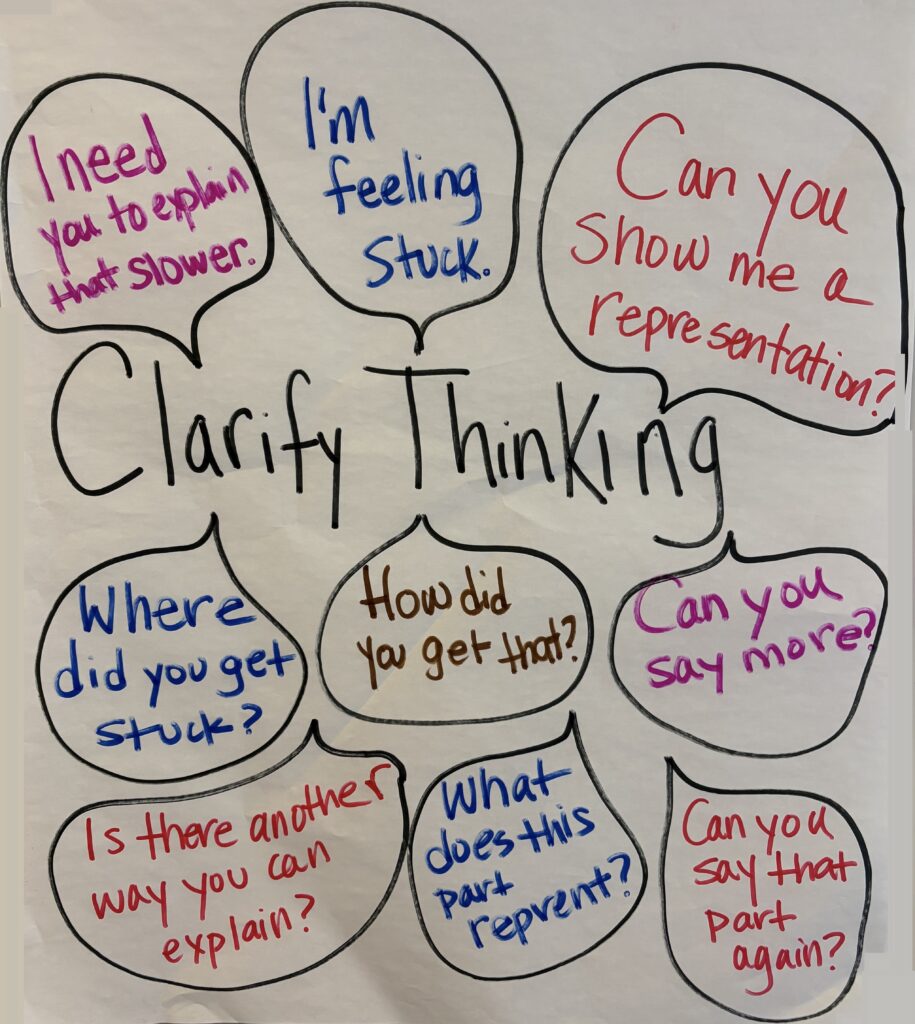
In doing so, Caroline refined the goal of small group work, shifting the focus from simply completing the math task to supporting a partner’s understanding, from reporting answers to helping someone make sense of the math.
The Power of the Reflection Cycle
Moving through a cycle of reflection allowed Caroline to shift from assumptions about group work to evidence-based action, while also affirming the strengths her students already brought to the table: a desire to include one another, a willingness to ask for help, and genuine enthusiasm for sharing ideas. With intentional support, those strengths became the foundation for more equitable and meaningful participation in small group work.
Caroline’s experience highlights the value of evidence-based reflection on small groups and pair work. Observing and documenting interactions allowed her to see not just who was participating, but how students were engaging and where collaborative habits could be strengthened. Tools like the Teacher Reflection Tool for Small Group and Pair Work give teachers a lens into these dynamics, helping them make intentional decisions to support equitable participation and ensure every student has the opportunity to be a thinker, contributor, and valued member of the classroom community.