
Quilts: Connecting Math, Art, and Communities in the Primary Grades
by Megan Murray
Updated December 4, 2025
Excursions are freely available sequences of related activities that encourage students to apply the mathematics they are learning to their own and others’ lives and communities. They were developed by the Forum for Equity in Elementary Mathematics to foster authentic connections between the mathematics students are learning in school and their experiences at home and in their communities. This blog illustrates the principles of Excursions, laid out in the introductory blog, in the context of a specific Excursion. It is the first in a series that will share the experience and work of field test teachers and students engaging in each of the published Excursions.
Sitting at the intersection of art and mathematics, quilts can play and have played an important role in families and communities at different times and across generations. In the Quilts Excursion, first and second graders learn about a community in Gee’s Bend, Alabama, that has made quilts for generations—quilts that have become renowned as sources of inspiration and pieces of art.
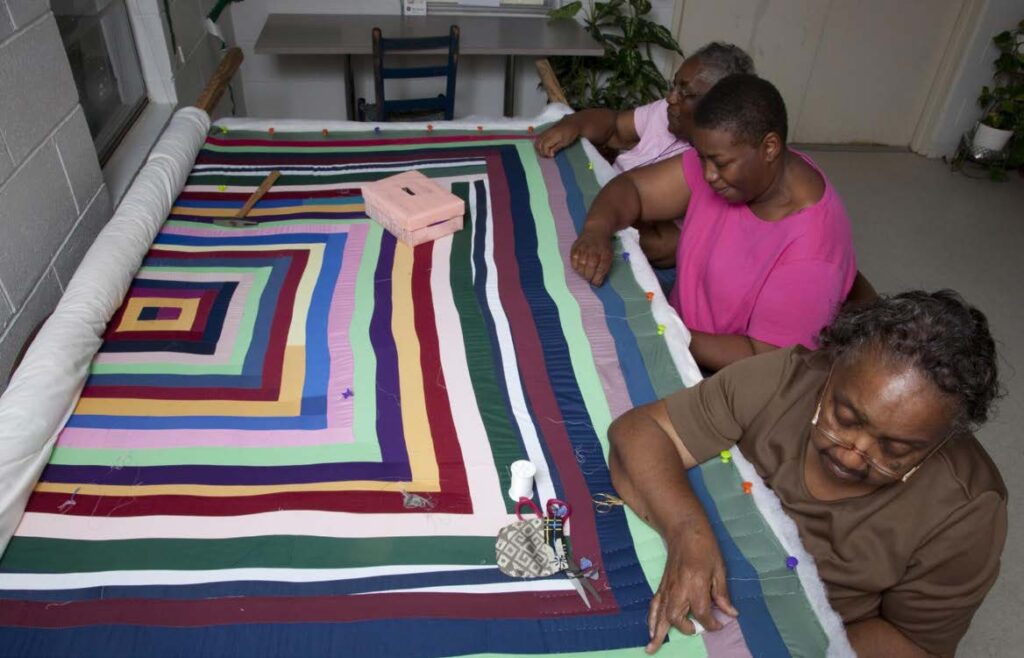
Students look at examples of quilts, share pictures of and stories about quilts from their families and communities, and design and make their own paper quilts. The work focuses on important mathematical ideas: composing and decomposing shapes, seeing relationships between squares and triangles, repeating a unit to create a new pattern, and seeing how shapes can come together to make new shapes.
Interviewing someone at home about quilts brought family stories into the classroom and sparked conversations about other things in their homes that came from family members.
“One little boy, the first story that came back, said ‘My mom has a special quilt. My grammy made it out of my mom’s baby blanket. We put it under the Christmas tree every year. It’s made out of squares. There’s red, blue, green, yellow, and white.’ He drew a picture of it, and that family sent in a picture of the baby blanket under the tree and when the kids saw that, it sparked a massive discussion about having things from family members in your house and that was a wonderful, wonderful discussion. It just kept going and everyone shared, including my multilingual learners – ‘mi casa, at mi casa!’ – so that was really nice. It was personal for the kids. They’re telling their own story.” – Kara, Field Test Teacher
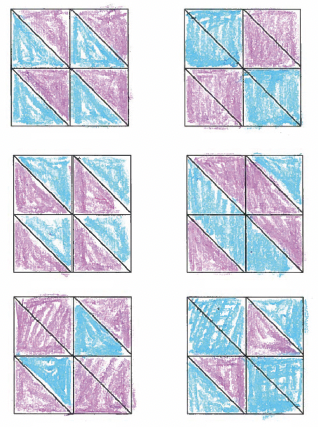
Exploring different ways to use two colors to design a single square, made of triangles and squares, led to interesting explorations. For example, the following student challenged themselves to find a different way to color each of the six squares on their sheet. Do you think they found all the possible ways? Can you imagine other ways?
Choosing a favorite square, to iterate into a quilt, encouraged students to imagine what the final product might look like. Look at quilts made from two of the quilt squares above. Can you tell which square they chose to iterate?
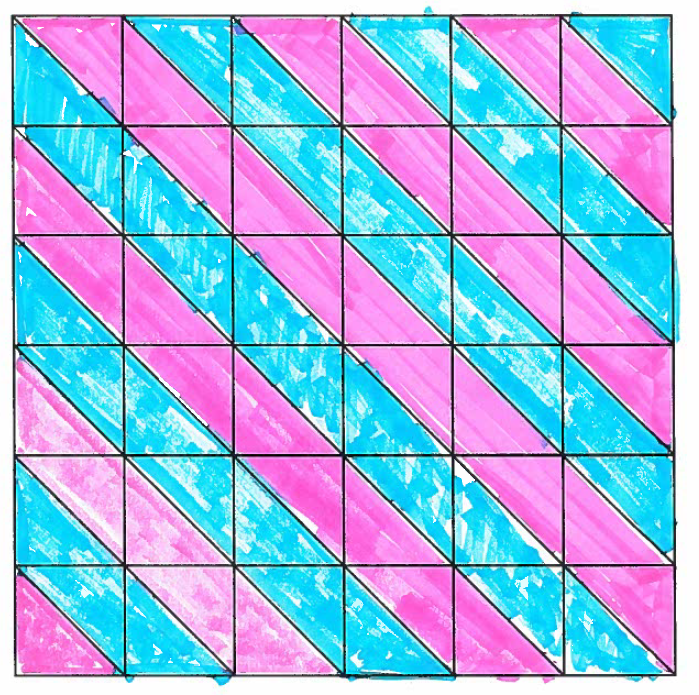
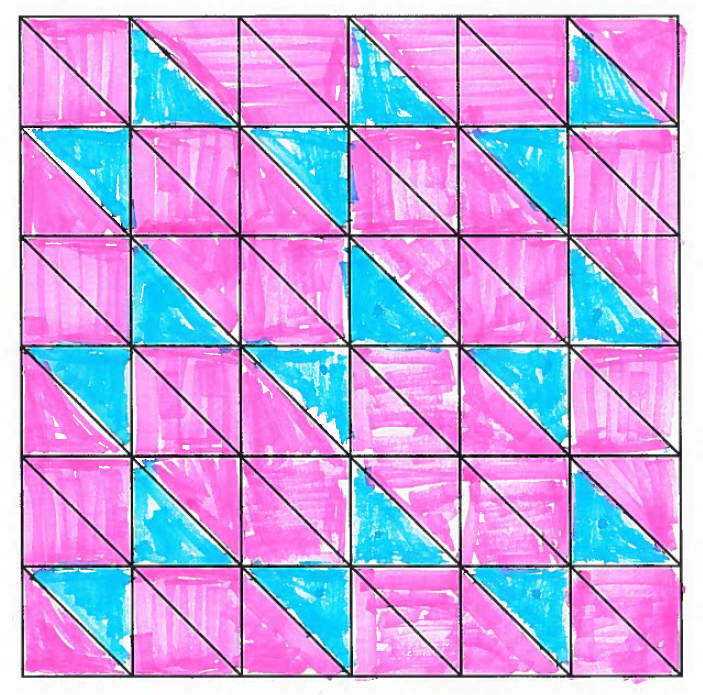
As students shared their quilts with each other, they were particularly focused on and excited about places they could see shapes coming together to make other shapes, and any “new” shapes that showed up in the full quilt.
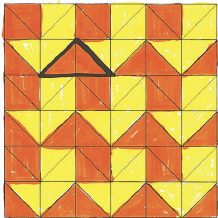
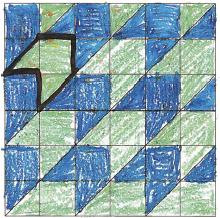
“There was one girl who, when she finished, was surprised when she saw the triangles turning into larger quadrilaterals. So we put it under the document camera so everyone could see it large up on the board. And the kids were like ‘Oh! I didn’t expect that!’ and ‘Whoa!’ And they came up to touch and trace it. It was a really good discussion.” – Kara, Field Test Teacher
“The discussion was really successful. Everybody knew their work was going to be seen and I was really impressed with the connections they made. ‘That looks like so and so’s quilt!’ and ‘That looks like this one!’ When I showed my multilingual students’ quilts, they came up and talked in front of the class, and everyone was genuinely listening and engaged which doesn’t always happen. And the person sharing was really proud. It was just really authentic, deep conversation.” – Anna, Field Test Teacher
Each Excursion includes extensions that allow students to pursue their own questions and interests, explore related topics, or share what they’ve learned. Teachers could “go deeper” in the Quilts Excursion by sharing literature about quilts and/or Gee’s Bend, by visiting a quilting studio or bringing quilters into school, or by sharing students’ work with families and/or other people in their school. Two of the field test teachers created displays in the hallway to share with the school community.
“I really enjoyed this Excursion. It felt really authentic, we had a lot of buy in, kids were super excited about it, everybody could access it, and they were thrilled to have their quilts hanging up in the hallway. Overall it felt like a really positive week of learning.” – Harriet, Field Test Teacher
What we heard from teachers who field tested the Quilts Excursion, and other Excursions across the grades, echoed the goals laid out in the introductory blog. The mathematics was accessible, deep, and rich. Students were more engaged and exhibited persistence. More children contributed to whole class discussions, expanding the voices heard in the classroom. Teachers learned more about students and their families, and students learned more about each other. Look for future blogs, which will take up these same themes in the context of other Excursions.
Resources
1. Highsmith, C. M., photographer. (2010) Women from Gee’s Bend work on a quilt. Gee’s Bend, Alabama. United States, 2010. April 5. [Photograph] Retrieved from the Library of Congress, https://www.loc. gov/item/2010639062/.
2. Rothstein, A., photographer. (1937) Sewing a quilt. Gees Bend, Alabama. Wilcox County United States, 1937. Apr. [Photograph] Retrieved from the Library of Congress, https://www.loc.gov/item/2017775821/.
