
Stories from the Field: Making Decisions with Students Instead of for Them
by Megan Murray
October 7, 2026
How do teachers know what students think about mathematics and math class? One way is to ask them! In this blog, Laura, a math coach in a small suburban district, describes working with Jannette, a fifth-grade teacher, to learn about students’ views about working in groups in math at the start of the school year. What they learned challenged their assumptions and shaped their plans for the year ahead.
This district begins the year with YouCubed’s Week of Inspirational Math, using resources that “engage students as creative problem solvers and help them develop a growth mindset about mathematics.” Given the goal of impacting the way students think about and experience mathematics, the team decided to use the Student Reflection Tool to find out what students liked and disliked about doing math in small groups.
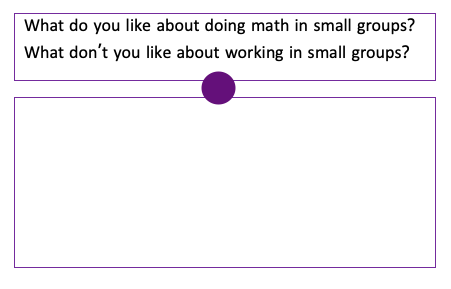
Laura was aware of assumptions some educators had about how students would respond.
“Some people assumed that kids would say, ‘I like it when people solve the problem for me’ or ‘I don’t like to talk. I like it when somebody gives me the answer.’
Instead, the team’s findings challenged those assumptions.
“In fact, what students said was the complete opposite. They didn’t like it when people interrupted their thinking. They didn’t like it when people gave them the answers. They didn’t like it when other kids took over.”
For Laura, the students’ responses underscored the importance of asking students directly about their classroom experiences.
“I was stunned by this. I thought, ‘Wait a minute, these kids are in fifth grade and we’ve never actually asked them this question before! We haven’t listened to their voices and we made all sorts of assumptions about what they might say.”
Teachers’ assumptions and students’ responses shaped Laura’s plans for the upcoming year. She decided to continue using the Student Reflection Tool to gather student feedback, and to think about how to utilize that feedback in an ongoing way, to center students’ voices. This process informed instructional decision making and also supported the development of a responsive math community.
“So the Student Reflection Tool has provided the opportunity for kids to actually share what they’re thinking and feeling, to learn that they have a voice, that they are being listened to, and that they can reflect on themselves as learners and be conscious about it and teach us something about it too.”
A single question from the Student Reflection Tool gave this teacher, and the coach, a window into how students were experiencing math class. The data not only informed their practice, but it provided fodder for discussions among teachers and with students, about how a math community should operate. The process communicated to students that their teacher was interested in their ideas and invested in creating an environment that supports and works for everyone. What a lovely way to start the year. Listening to students, though, is not just a beginning-of-the-year activity; it is an ongoing practice that helps teachers make instructional decisions with students rather than simply for them.