
Emotions in Math Class: How Student Reflection Can Build Awareness and Resilience
by Marta Garcia and Megan Murray
March 30, 2026
In a previous blog, we wrote about how our work with a group of educators resulted in a tool that encouraged students to reflect on their math experiences in ways that helped teachers create more equitable learning communities. In the course of field testing and improving the tool, teachers shared stories that captured the impact of consistently asking students about their experiences as math learners and reflecting on what they learned. They found that setting aside time for students to reflect contributed to a classroom culture built on trust, honest feedback, and open communication. That led us to think about how student reflection might support students and teachers in recognizing and working through emotions that might interfere with learning in math class.
How Emotions Impact Students’ Experiences in Math
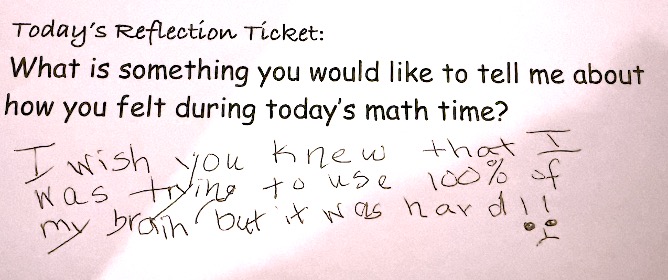
Third grader Neesha, who shared her experience in an exit ticket, expressed how hard she was trying to learn and that “it was hard.” Articulating her feelings provided a chance to identify emotions impacting her learning and also offered the teacher an opportunity to better understand Neesha’s experience. There is a growing body of research on how the brain works that can impact the decisions we make as teachers. (Safir, 2017; Hammond, 2014; Lambert, 2024).
Researchers describe three important areas of the brain:
- The Brain Stem – “lizard brain”
- The Limbic Region – “emotional brain”
- The Neocortex – “thinking brain”
The “lizard brain” is responsible for alertness and attention. The limbic system regulates emotions. (Hammond, p. 38) When students experience changes or threats in the environment (i.e. exhibitions of status, strong emotions, fear of wrong answers), these parts of the brain can trigger a fight or flight response, interfering with students’ ability to grow and learn. In other words, math anxiety and negative perceptions of math can impact students’ ability to use their “thinking brain.”
Using Student Reflection to Uncover Emotions Impacting Learning
The impact of negative emotions on learning might be obscured if the focus is primarily on how students are progressing with math content. Asking students to reflect on both past and current experiences in math class, using questions like the ones below, can uncover emotions and experiences that are impacting their learning.
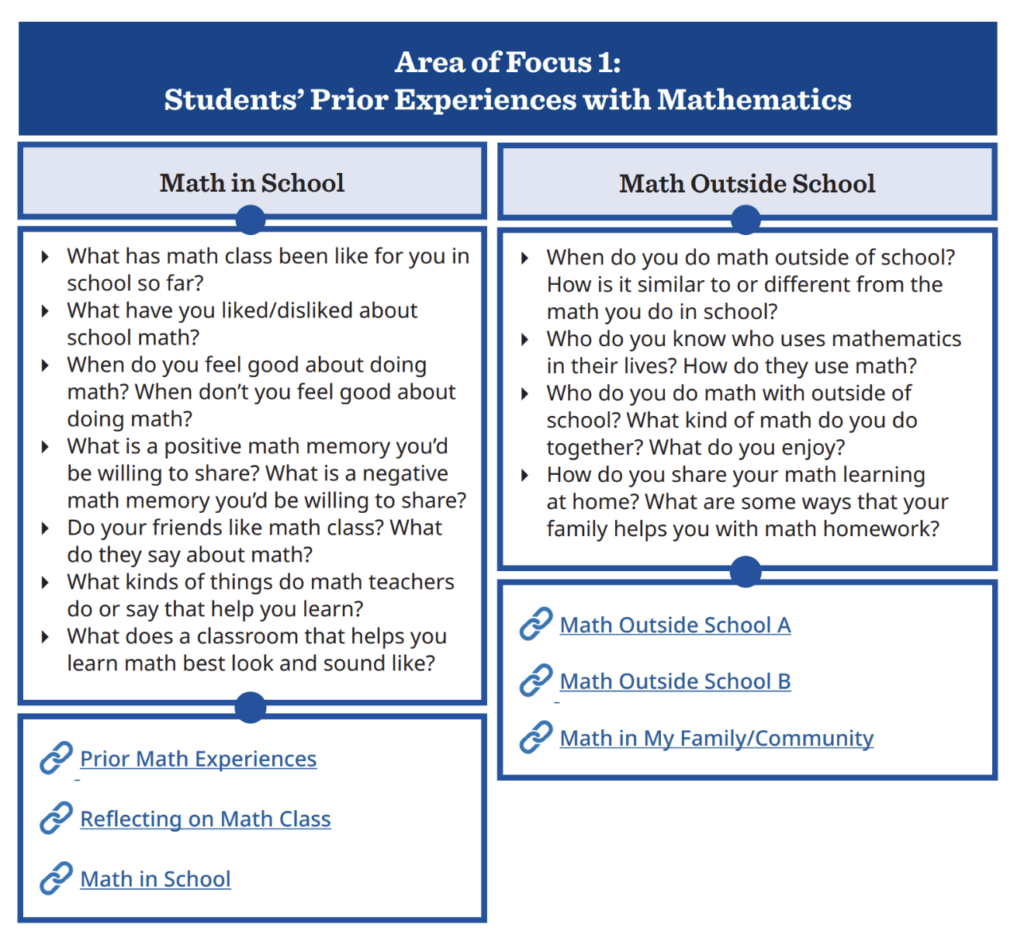
Students’ responses can reveal how they are experiencing math class, allowing teachers to use what they know about how the brain responds to negative stimuli to develop awareness and resilience. In this way, students and teachers can implement strategies that help students feel calm and accepted during math time. In other words, being attentive to students’ emotional states and needs can help teachers negotiate and transform aspects of the learning environment that may be prohibiting students from fully participating.
Using Student Reflection in the Classroom
In the following vignette, a teacher uses student reflection to better understand students’ perceptions of mistakes in math and how those perceptions are impacting their learning.
Fifth grade teacher Caroline was wondering about how students were experiencing mistakes in math. She chose to pose the highlighted questions to the class:
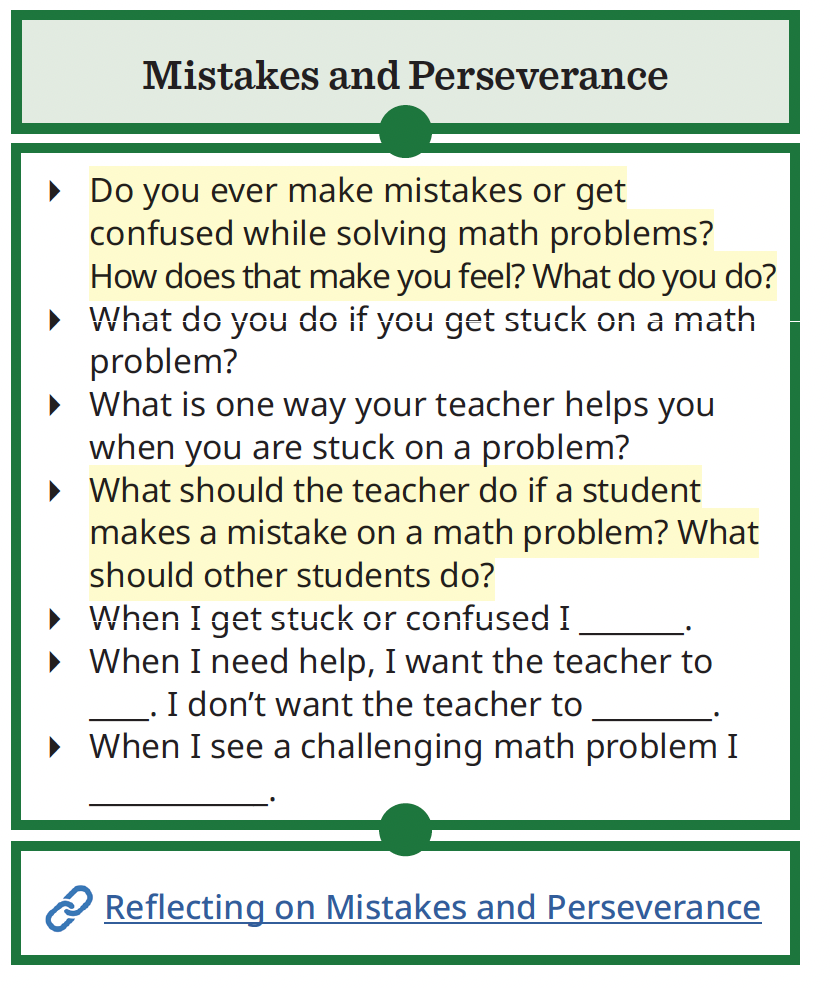
Students’ responses indicated that there were some issues clearly connected to emotions to reflect on:
“First, almost all students identified that they struggle and get confused sometimes. They said that they felt mad or upset about being confused and making mistakes. Second, there were some insightful responses about what they wanted from their teachers. I think it is interesting that while students acknowledged that they have negative feelings when they are confused, they still wanted support that would not rescue them but help them move forward.”
Caroline decided to interview a few students with some follow up questions from the Student Reflection Tool.
- How do you feel when you make a mistake during our math class?
- Why do you think you feel that way?
She reflected on what she learned about one of those students:
“I had a student tell me in her interview that she was nervous about how her peers view her as a learner and as a mathematician. She was very worried that people would laugh and make fun of her if she made an incorrect statement and that she would be viewed as stupid if she took a risk and said a wrong answer. She talked a lot about her feelings of the class’s perception of her, and her worries of being judged.”
Caroline was able to learn how a student’s perceptions and emotions were prohibiting her from full participation. This student was reluctant to share ideas both in small and whole groups. Caroline now understood that the students’ fear of making mistakes was creating a “flight” reaction to presenting, sharing, and extending her mathematical ideas. The teacher used all of this information to plan some action steps.
“I decided that we needed to do some explicit whole class norming about what it means to be a community of math learners—that we are here building an understanding together, and that means that not only is it important for me to understand it, but it’s important for me to be able to explain it to you, and for you to understand it. I was really explicit about what we do when people make mistakes, and about how we support people in risk-taking and we also discussed the benefits of making a mistake. We did a lot of putting up an error and using it to help us find the correct answer and saying ‘Oh, okay, well if this isn’t right, that tells me something about the problem, and that information helps me solve it better.’”
As Caroline monitored the impact of the moves she was making and the conversations she was having, she started to note some shifts.
“Those explicit whole class moves started creating a community where kids were excited when someone asked them to explain their thinking and helped create a community that allowed that one student to start thriving. The student I interviewed is now at the point where she said, ‘Oh, I’m going to come up and show what I did.’ So what we were doing worked really well for her. I’ll call on her and she’s like, ‘Well can I just come up and write it?’ I’m like, ‘Yeah, I would love for you to do that.’”
Teachers like Caroline, who integrate the use of student reflection throughout the year, note that students are more likely to identify when their emotions are impacting their engagement or learning during math class. They become better able to self monitor their responses or to alert their teacher that they are feeling frustrated or close to shutting down. In this way, students begin to see how reflecting on their emotions can improve their experiences in school.
Using Student Reflection to Impact Learning in Math Class
When students are able to share their feelings and experiences, the classroom community has an opportunity to address barriers to learning and to celebrate aspects of the classroom environment that support positive experiences.
“I think that using the tools impacted my students in that they [felt] like they could share their thoughts with me, and it had them also pause and think, what do I think about what good math is? It’s not even just at the beginning of the year where that is part of the way we launch the year, but later in the year, to pause and think, like that this is something important to think about. So the interviews or surveys really helped with that.” – Tina, Fourth Grade Teacher
Activating positive emotions through reflection can impact the parts of the brain that control learning. When students are asked to give feedback on how they are experiencing math class, they recognize that they have a role in the development of their classroom’s culture. Teachers in turn can use students’ responses to plan for and develop strategies that will support a positive climate for learning.
Resources
Garcia, M. & Sussman, A. (October 25, 2023). A Cycle of Reflection: Learning More About Our Students. Math Equity Forum Blog.
Hammond, Zaretta. (2014). Culturally Responsive Teaching and the Brain. Corwin.
Lambert, Rachel. (2024). Rethinking Disability and Mathematics. Corwin.
The Math Equity Forum at TERC. (2023, October). Student Reflection Tool: Getting to Know Your Students. Forum for Equity in Elementary Mathematics.
Safir, Shane. (2017). Listening Leader. Jossey Bass.