
Using Student Reflection to Inform a Strength-Based Approach to Math Learning
by Annie Sussman
January 13, 2026
Taking a strength-based approach to learning is an important part of developing an equitable math classroom (Russell, 2023, p. 8). Acknowledging what students understand and using that information to provide targeted feedback and responsive instruction not only promotes learning but also sends a powerful message to students that everyone is a math thinker, sense-maker and problem-solver.
Inviting students to reflect on positive math experiences can help teachers recognize and build on students’ strengths and current understandings. Asking questions or providing prompts about what students feel proud of in math, as well as the kinds of support they find most helpful, deepens teachers’ knowledge of their learners and strengthens students’ confidence, self-awareness, and sense of agency.
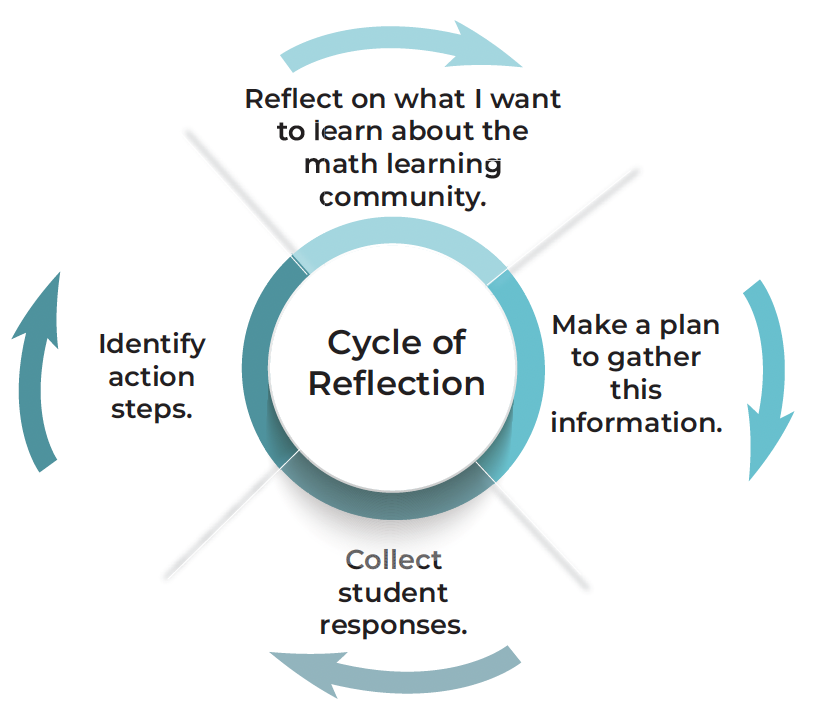
The Student Reflection Tool, developed by the Forum for Equity in Elementary Mathematics, contains many questions and prompts that can be used to inform a strength-based approach. Additionally, the Tool outlines a process, referred to as the Cycle of Reflection, that guides teachers as they determine their focus for this work, collect and analyze students’ responses, and consider possible action steps based on what they learn.
Emma’s Story: Learning Through a Cycle of Reflection
During a unit on fractions and decimals, fourth grade teacher Emma reflected:
“Many of my students come into our fraction unit believing they’re not good at fractions. I wanted students to see that there has been so much growth, and I wanted to give them an opportunity to stop and celebrate that growth. I also wanted to learn more about what helped them develop the understandings they felt proud of so that I could provide more targeted support.“
Given these goals, and her desire to learn more about students’ developing understandings of and experiences with fractions and decimals, Emma asked students to respond to the following prompts:
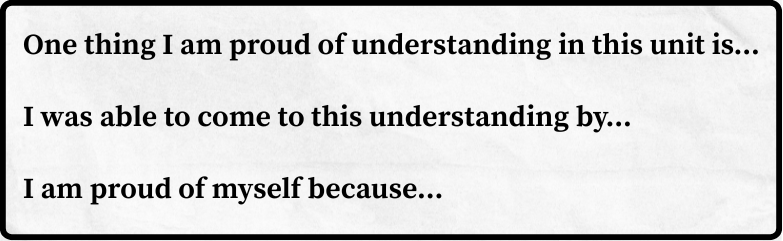
She compiled students’ answers in a spreadsheet. As she looked across the responses, 2 things stood out:
- Almost all the students wrote that working with others helped them develop their understandings of fraction concepts. Emma was pleased to hear this because supporting productive partner work in math had been an important goal during the second part of the school year.
- Many of the students wrote about specific tools and representations that helped them make sense of fractions.
In addition to these observations about the class, a particular student’s response really caused her to reflect:
“I have one student who does not have a lot of confidence in math. Early in the unit, we were playing a fraction equivalence game, and he was trying to figure out how three twelfths were equivalent to one fourth. I was trying to guide him with some questions, but he was very much like, ‘No, I want to figure this out on my own’. I left him with a four by six rectangle. After about 15 minutes of reasoning and shading in, he figured it out, and he was so proud of himself. At the point that we did this reflection, close to a month had passed since that day, yet he chose to reflect on that experience. He wrote ‘I’m proud about the game we played. I got the hard fraction three twelfths is equivalent to one fourth’. Not only did he remember that three twelfths are equivalent to one fourth, but that feeling that he had in that moment was clearly something that stuck with him even now weeks later. It is powerful to know that some of those small moments that we see every day are really sticking with kids.“
This experience showed Emma that seemingly small instructional moments can have a lasting impact on students’ mathematical identities. The chance to struggle productively, arrive at an insight through their own reasoning, and feel recognized by their teacher can be profoundly meaningful.
It also informed the ways Emma planned to continue to provide support for all her students:
“They made me aware that I really need to make sure that I have manipulatives available and that I need to be explicit that these tools are not just for some students, but for everyone. I am also going to continue to provide lots of opportunities for partner work and continue to offer students time to discuss and reflect on how partners can help each other.“
In addition to thinking about specific actions, Emma also talked about the impact that reflecting on positive aspects of math learning had in her classroom:
“I had this realization that stopping and celebrating growth is really powerful for both the students and for myself. Every time that my students can stop and celebrate success it builds their confidence and belief in themselves as mathematicians. Time is always of the essence as a teacher. As a newer educator, I think I can get bogged down and focused on the couple of students who still don’t seem to be grasping it and what isn’t going well. This experience has helped me be able to stop and see that there is so much growth and great math thinking from every single student happening in the classroom.“
Moving through a cycle of reflection offered Emma insights into her students’ growth, their developing understandings, and the forms of support they found most meaningful. Just as significant, she began to see how celebrating growth could nurture students’ developing math identities. Emma recognized how even seemingly small moments could be impactful when students were given space and support to grapple with challenging ideas. In doing so, she gained a clearer sense of the impact she as a teacher could have. These insights underscore the benefit of truly getting to know students as math thinkers and utilizing this knowledge to develop supportive accommodations that help students make sense of important mathematical ideas for themselves.
References
Russell, S.J. et al. (2023). A Framework for reflecting about equity in the elementary mathematics classroom. The Forum for Equity in Elementary Mathematics. Retrieved from: https://www.terc.edu/mathequityforum/terc_products/framework-reflecting-about-equity/
The Math Equity Forum at TERC. (2023, October). Student Reflection Tool: Getting to Know Your Students. Forum for Equity in Elementary Mathematics.
