
About Sound Travels
Every educator knows it is tough to compete with a baby’s cry.
Every parent, guide, docent, and educator knows it. Some researchers have claimed that it is impossible not to process auditory information. Everyday sounds are part of our lives.
Some are personal: the sound of chewing, our footsteps. Some are like the hum of a refrigerator, so expected that we don’t pay them much attention. And some noises are so shocking or annoying that we have to pay attention.
Sounds of all sorts can drastically change how we learn and interact in different settings.
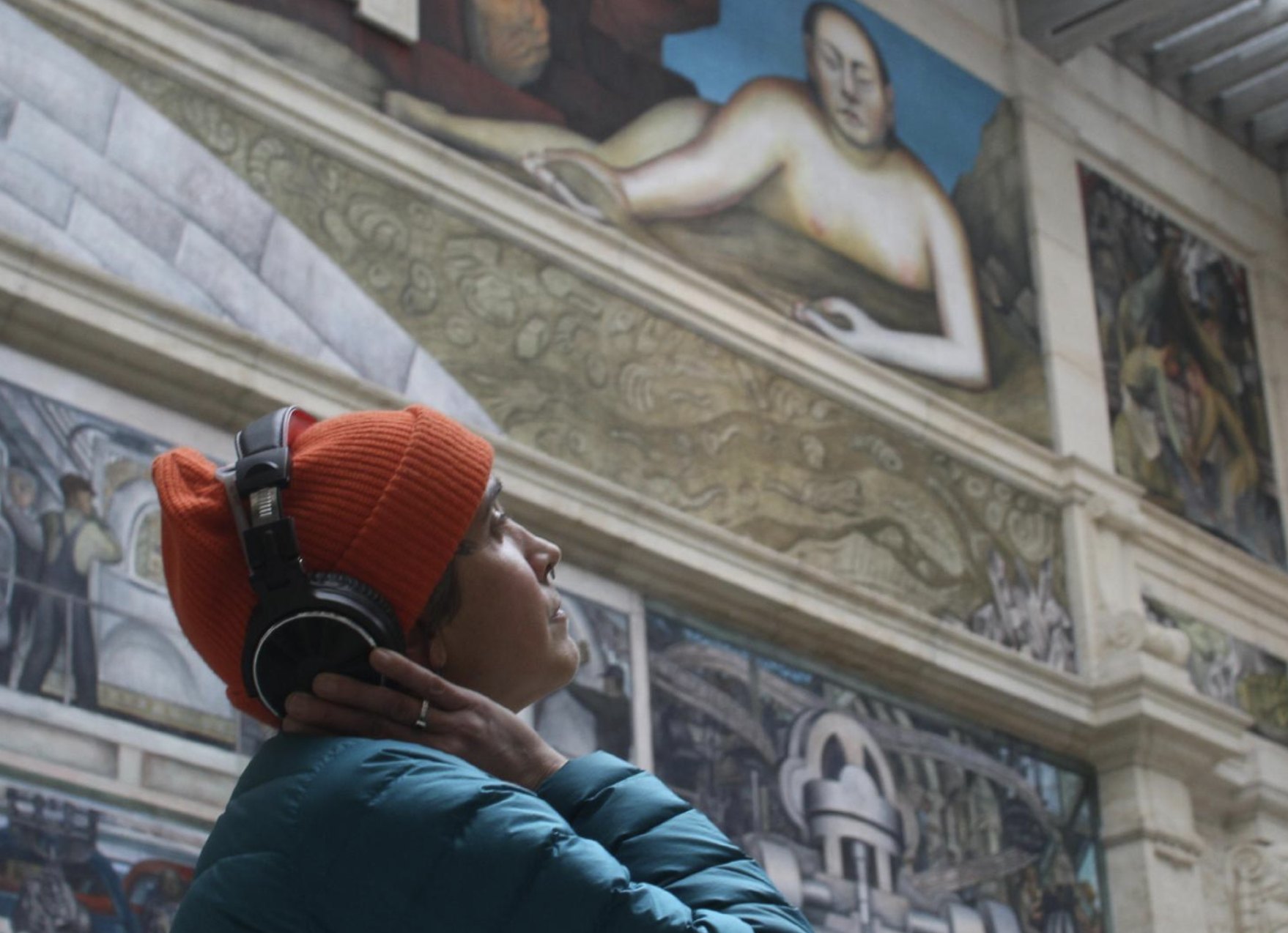
Sonic agency
You have more choice over what you hear than you think
Sound Travels is built on a simple idea: listening is something we do, not something that happens to us. Follow a songwriter through the sounds around her as she composes a song, and notice how much choice we have over what we hear. A 10-minute StoryMap by Eriu Martinez and Billy Mark.
Where we are
Analyzing an extensive data set
As the first study of its kind, we looked at dozens of variables. Where visitors grew up, their cultural and religious practices, and their affinity and identity with respect to music could all affect how sensitive or oblivious they are to soundscapes in informal learning settings. Analysis is ongoing.
~500
hours of audio recordings
140
sound searches: visitor-driven recordings and interviews
~1,000
questionnaires
~100
variables measured
First round of data collection, Columbus. Read more about the research and its findings →
The objectives
Over four years, the Sound Travels team of partners and researchers set out to:
01 Understand soundscapes
Understand soundscapes as they exist in different informal learning environments like zoos, parks, and science centers, and identify specific spots, exhibits and programs to investigate.
02 Collect, analyze and interpret
Collect data, analyze, and interpret the relationships between sounds and learning.
- What qualities of sounds attract attention?
- What qualities of sound hold attention?
- What qualities of sounds seem to connect with social learning: conversations, figuring out puzzles, siblings, caregivers and children learning together?
03 Share findings
Share findings with those who will help prioritize questions, laying the groundwork for future research.
Throughout, the goal has been to tease out these relationships and share insights that help informal STEM professionals design and plan for increased attraction, attention, and shared learning among visitors.
The project in three minutes
Introducing Sound Travels
The question, the places, and the people doing the listening. Researchers and learning designers introduce the project in their own voices.
Sound Travelers
The team
Project leaders
Researchers
Advisors
- Cesar Almeida, Solidarity Studios and Creative Capitol
- Eric Leonardson, Midwest Society for Acoustic Ecology
- Victor Minces, University of California, San Diego
- Amaris Alanis Ribeiro, Trinity River Audubon Center and Hispanic Access Foundation
- Hanbing Liang, University of Wisconsin-Madison
Artists
- Billy Mark, Neighborhood Art School, Detroit
- Teagan Far
- Isabella Febbroriello
- Amanda McCluskey
- Nita Sturiale
- Notable Human Films, Alexis Brunnert and Nathan Knox