
Volume 3, Issue 7 | September 2026
Greetings from TERC! Most of you are well launched into the fall by now, and this newsletter is evidence!
Deadline for our Next Newsletter: October 20th. Send news! Share about things you’re trying in your classrooms that connect climate and/or equity. Tell your colleagues about presentations you’re making, or articles you’ve written. Send suggestions and comments about resources you’re finding useful — or questions and queries about topics you’re developing, or challenges you’re grappling with, which your colleagues may have ideas about or help you workshop.
Next call-back: Monday, October 26th at 8 pm Eastern Time. Emily Whitton (2026) will share about transitioning her Environmental Science course to CTE Environmental Education, where her high school students will teacher younger learners in our district about Environmental Science topics. More details to come! If you’d like to present at a call-back, please contact Brian to plan and schedule. The presentations can take many forms and be of any length, so don’t be shy.
News from Climate and Equity Fellows
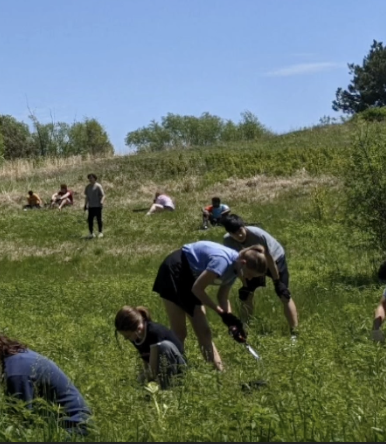
Carl Armstrong (2022) reports (amidst a school in major renovation) that in his continuing prairie restoration (see his Kaleidoscope article) project, students last year planted around 5,000 seedings; the refrigerator at school is full of this fall’s seeds, quietly stratifying in preparation for next year.
Spencer Cody (2023) writes from South Dakota that he’s taking his students to Biosphere 2 in March to work on carbon cycling.
Bess Hjartarson (2023) reports that her students will soon be involved with the annual bison harvest under the auspices of the Blackfeet nation.
Sean Tracy (2024) has written two new Ecology courses (with support from the Arlington County (VA) district), “both of which I am teaching this year – and figuring out on the fly. One is an Honors/Intensified Ecology, the other is for students who passed Biology, but failed our state exam. The idea is to get them an Eco credit as a different science towards graduation, but also prep them for a test retake.”
Diana De Paula (2023) writes “I was selected to stay for an additional year as an Albert Einstein Distinguished Educator Fellow in Washington, D.C. After years of teaching science and special education in Brooklyn, it has been quite a journey working on Capitol Hill. I’ve been serving in Congresswoman Suzanne Bonamici’s office, focusing on education, STEM, workforce development, and artificial intelligence policy. The lessons from the Climate and Equity Institute—especially our conversations on climate education—remain deeply relevant to my work, and I’m very grateful to you and the team for that experience.”
Finally: The schools we work in are part of the social fabric. We note with sorrow that several teachers have reported on ways that the ICE immigration surge of the past two years is reaching into their communities, and consequently into their schools.
Presentations
As some of you may know, the NSTA National Conference will be held in Boston this spring. With the conference right in our backyard, TERC is planning to have a larger presence than usual.
As we make our plans for the conference, we’d love to know if you are already planning to attend or participate. If you expect to be there and would be interested in connecting with the TERC team during the conference, please let us know soon.
Sean Tracy has been accepted as a workshop presenter at the Society for Conservation Biology’s International Marine Conservation Congress in Edinburgh, UK (in mid November). The workshop description: Addressing Social Justice Through Environmental Education: Problem-based Lesson Development: Educators will collaborate to develop student-focused, problem-based lessons that integrate social justice into environmental curricula. The goal is to provide students with tools for local stewardship and advocacy within their specific communities.
Kirstin Milks (2022) and Whitney Aragaki (2025) will speak at NSTA this fall on the rich intersection of place-based science teaching and innovation education. Kirstin will also be at the National Association of Biology Teachers, in particular supporting potential authors for the organization’s wonderful journal, The American Biology Teacher.
Kirstin also writes: “The new Editor-in-Chief at ABT is very excited about publishing descriptions of practice from a wide variety of life science educators… maybe some of our Climate and Equity folks? Please come say hi if you’re in either spot (NSTA or NABT).”
Bess Hjartarson (2023) will be presenting at NABT, too. Her project at the Climate and Equity Institute was developing an idea for a native plants garden at her school, and it is increasingly an alternative classroom not only for science, but for any or all subjects. She’ll talk about what’s developing there.
Sara Young (2022) and Carl Armstrong will once again be presenting a workshop on Climate and Equity.
Abe Cohen will present at the Geological Society of America in November on the Bronx River / Detrital Zircon Geochronology project he and his students have been conducting.
Resources

Spark Ed. Diana de Paula writes: “I recently started working on an app called SparkEd (beta link: https://sparked.ai.studio/). Having spent so much of my career searching for fellowships, grants, and institutes, I wanted to create a platform that makes it easier for educators to discover these transformative professional opportunities.”
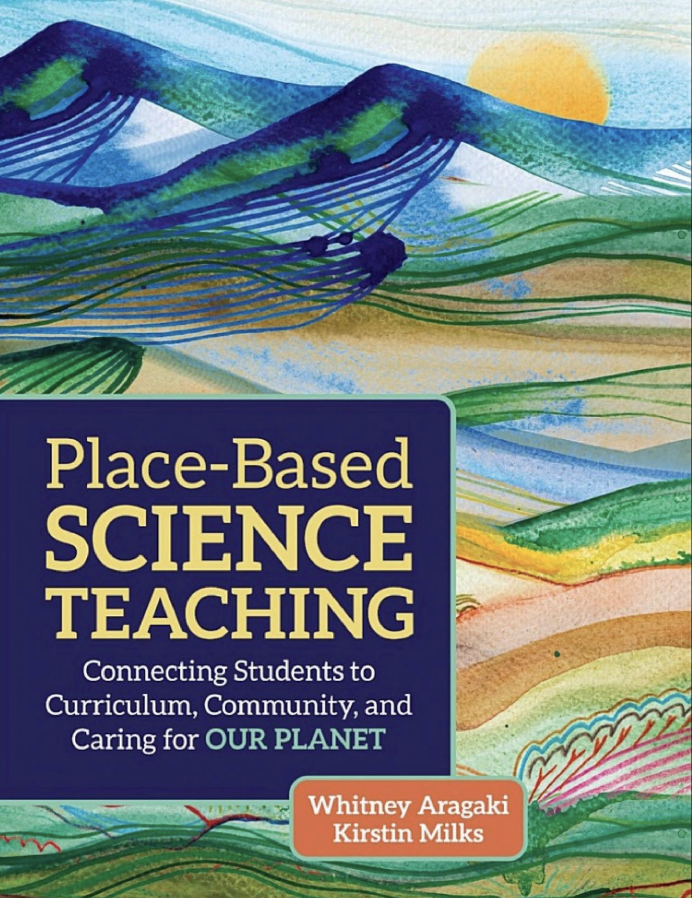
Place-based teaching. Have you checked out the new book by Whitney Aragaki and Kirstin Milks? Place-Based Science Teaching: Connecting Students to Curriculum, Community, and Caring for Our Planet — Send a note or review if you have!
“Identity, community, and place are tightly connected and can be leveraged to deepen science learning for students. Place-Based Science Teaching offers K–12 science educators an innovative approach to building learning experiences that embrace the rich and varied knowledge held by people, both past and present, about the places we call home. This book helps teachers to foster greater personal investment of students in their learning, as well as develop NGSS-informed authentic problem-solving and critical-reasoning skills. The book will also help teachers create and find joy in their classrooms by connecting lessons to local environments, cultural heritage, and global issues.”
Data centers. These huge, controversial centers with all their community and climate impacts can be a rich source of ideas for climate change education. Have you gotten into this? Gilly Puttick shares a link to a “green data center” project in Massachusetts. Check it out.
El Niño/ENSO. Are you teaching about this year’s unprecedented El Niño? Do you have resources to share? Ideas about how to approach it? Questions about how to make use of it in your context? Send queries to the Climate and Equity Fellows! One resource that came up in a call-back meeting on Sept. 28th was Berkeley’s Understanding Global Change. Have you used it? What do you recommend?
Now’s your chance!
Send us your ideas, your news items, or resource reviews by October 20th for next month’s newsletter.
Call-backs: Feel free to suggest topics for future call back sessions
Contact Brian at climateandequity@terc.edu with ideas and proposals!
The Climate and Equity project is funded by the John D. and Catherine T. MacArthur Foundation.