Will This Be on the Test? (October 2026)
by Aren Lew
Welcome to the latest installment of our series, “Will This Be on the Test?” Each WTBotT features a new question similar to something adult learners might see on a high school equivalency test and a discussion of how one might go about tackling the problem conceptually.
Download the Will This Be on the Test? packet
Browse the WTBotT index of posts
How do you understand fractions? The College and Career Readiness Standards for Adult Education suggest that students should be able to:
- Partition circles and rectangles into two, three, or four equal shares, describe the shares using the words halves, thirds, half of, a third of, etc., and describe the whole as two halves, three thirds, four fourths. Recognize that equal shares of identical wholes need not have the same shape. (2.G.3)
- Understand a fraction 1/b as the quantity formed by 1 part when a whole is partitioned into b equal parts; understand a fraction a/b as the quantity formed by a parts of size 1/b. (3.NF.1)
- Understand a fraction as a number on the number line; represent fractions on a number line diagram. (3.NF.2)
- Recognize and generate simple equivalent fractions, e.g., 1/2 = 2/4, 4/6 = 2/3. Explain why the fractions are equivalent, e.g., by using a visual fraction model. (3.NF.3b)
Those are only a few of the standards explicitly targeting fraction understanding. We can have a fraction of a shape, a fraction of a set (e.g., 2/5 of the cars are blue), a fraction of a number (e.g., 15 is 3/4 of 20), or a fraction as a point on a number line. Fractions manifest in many more ways than just two numbers separated by a line. Learning fractions through multiple models builds solid and transferrable understanding, and sometimes those models show up explicitly in test questions, too. Which models or understandings about fractions will help you with this question?
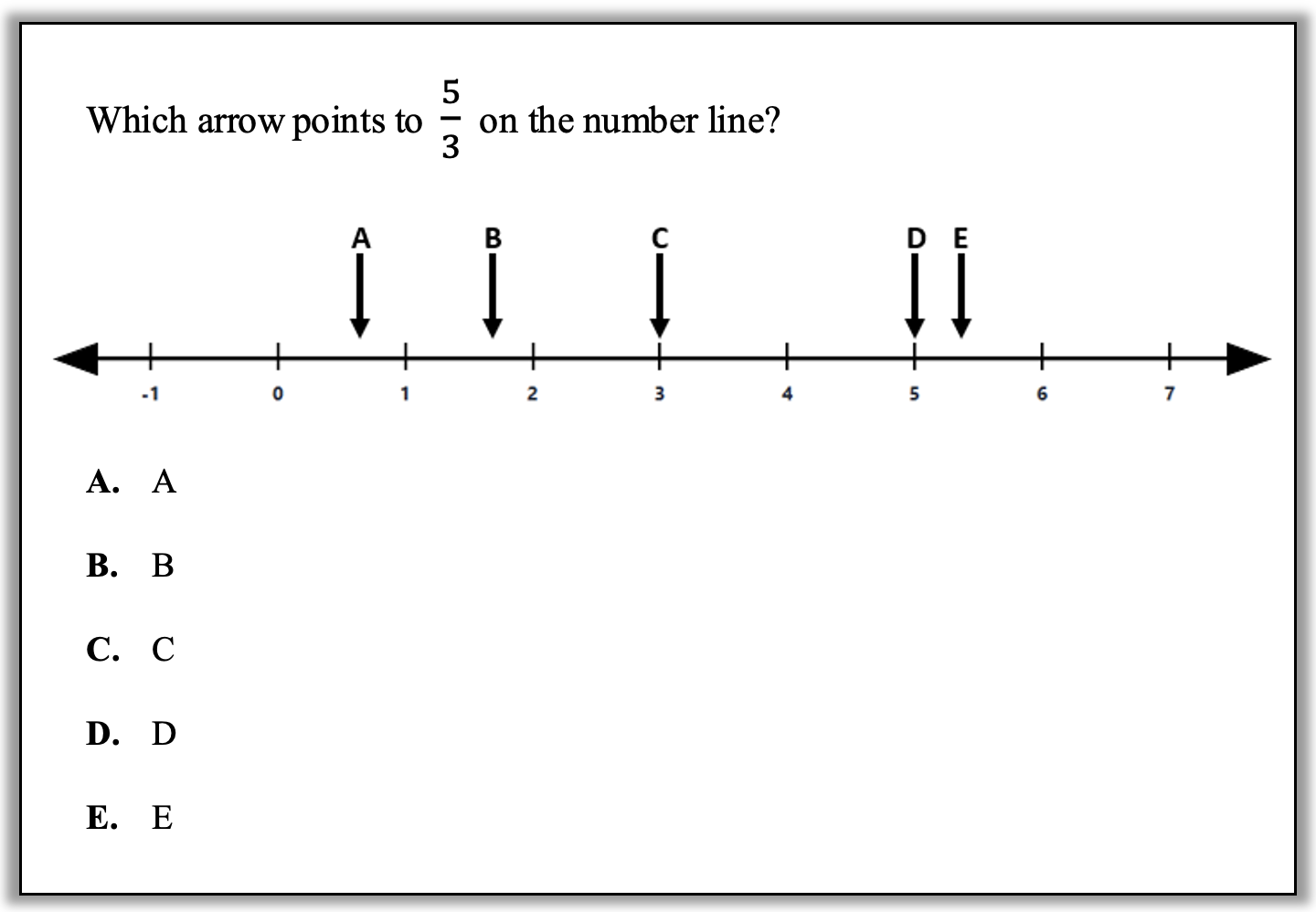
How can you approach this question in a way that makes sense to you? What conceptual understandings or visual tools can you bring to bear? What mathematical concepts do students really need to be able to tackle this problem? How might your real-world experience help you reason about this?
Here are some possible approaches:
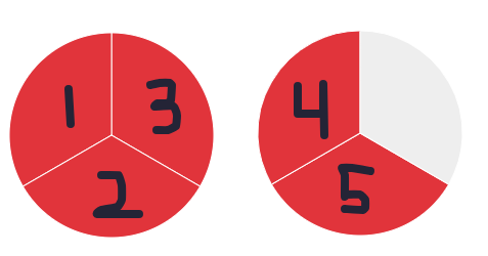
1. Draw a picture. One of the standards listed at the beginning of this blog includes, “understand a fraction a/b as the quantity formed by a parts of size 1/b.” That’s some very abstract language, but what it boils down to is understanding a third (for example) as an object—a piece—and a fraction, in general, as a group of pieces. What makes a piece a third is that when we put three of them together, we get a whole. Five thirds means a group of five pieces that are each one third. Drawing wholes divided into thirds and counting pieces until we get to five pieces gives a pretty clear picture of the size of the fraction 5/3. How does this translate to the number line?
2. Reason about wholes. The same reasoning a student might use with the pictures in the first strategy can also be accessed if a student is comfortable thinking about fractions as pieces more abstractly. Knowing that it takes three thirds to make a whole and that the value we are concerned with is five thirds, a student can reason that there are more than enough thirds to make a whole. Is it enough to make more wholes? How many thirds would it take to make two wholes? How can this line of reasoning tell a student which arrow on the number line points to 5/3?
3. Mark and count thirds on the number line. Another result of understanding “a fraction a/b as the quantity formed by a parts of size 1/b” is being able to count by a unit fraction (like 1/3 or 1/5), the same way you could count by any other object. Count Von Count from Sesame Street might count his bats like this: “One bat! Two bats! Three bats! Four bats! Five bats! Ha! Ha! Ha!” We can imagine him counting thirds the same way: “One third! Two thirds! Three thirds! Four thirds! Five thirds! Ha! Ha! Ha!” A student might make tick marks on the number line to show thirds and count up to five along those tick marks.

Take a minute to reflect on the number line and fraction understandings that make this approach possible. Students must be able to partition each whole into three parts by drawing two tick marks. They must understand how to reason about tick marks and intervals on the number line. They must know to begin counting at zero. Number lines are a powerful tool for reasoning, so students should be given lots of opportunities to build their skills using them.
I learned a procedure in school for converting an “improper” fraction to a mixed number. (“Improper” feels very negative—wouldn’t it be kinder and clearer to call it “a fraction greater than 1?”) The procedure involved division, remainders, and remembering where to put the numbers I got as a result of doing those operations. I have taught that procedure to students. But somewhere along the line, I started asking students if they could express a fraction greater than 1 as a mixed number without teaching them any steps or procedures. Students who had a conceptual understanding of the meaning of a fraction were able to represent quantities greater than one as a single fraction or a mixed number fluently from the start, mostly by drawing pictures. While drawing pictures or making tick marks on a number line could become cumbersome with larger numbers, starting with a concrete strategy with a strong conceptual foundation can eventually lead to generalizing reasoning. (See Standard for Mathematical Practice 8: “Look for and express regularity in repeated reasoning”.) Ultimately, students often ended up doing the same calculations I might have taught them in the first place, but by doing them in a way that made sense to them.

Aren Lew has worked in the field of adult numeracy for over ten years, both as a classroom teacher and providing professional development for math and numeracy teachers. They are a consultant for the SABES Mathematics and Adult Numeracy Curriculum & Instruction PD Team at TERC where they develop and facilitate trainings and workshops and coach numeracy teachers. They are the treasurer for the Adult Numeracy Network.