Why computer science?
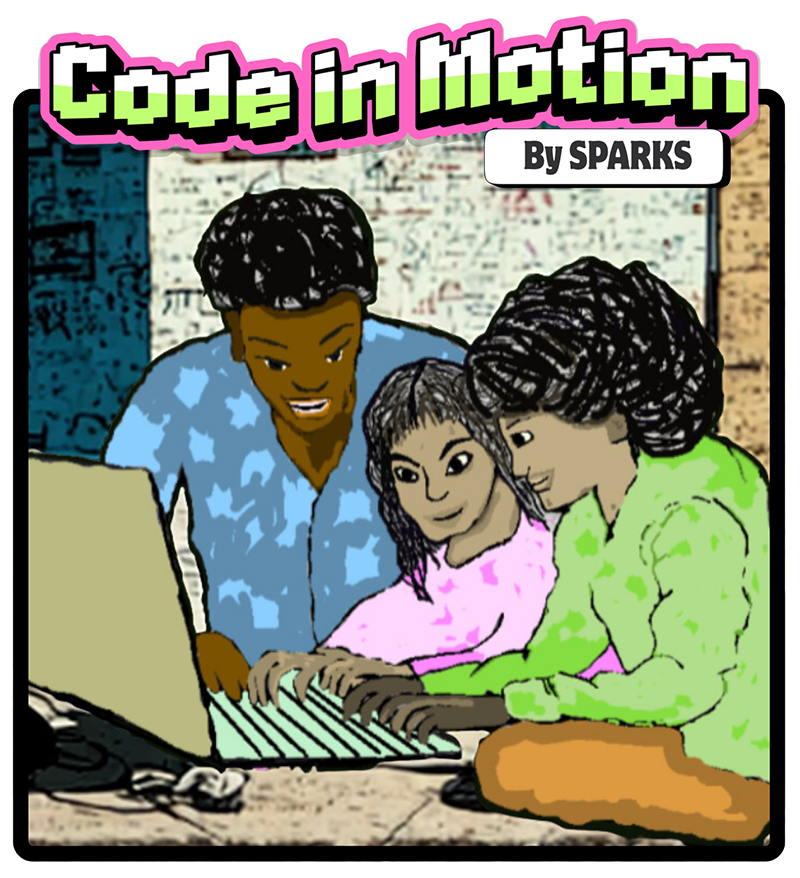
Coding impacts many things in modern life. Coding makes smart phones function or perform actions like controlling traffic lights!
Learning about coding helps students become creators and not just consumers. Coding requires using computational thinking skills. Everyday, we use computational thinking in order to perform small to large tasks.
And anyone can learn to code! Below are some vocabulary words and terms you may hear when people talk about computer science and coding.
Block coding is a programming method that involves dragging and dropping digital blocks to create code. It is designed for beginner codes to learn programming logic. Scratch is a free block coding program available online.
Code in Motion activities often include using Scratch, a block coding tool. You can see more at https://scratch.mit.edu/
Code refers to a set of written instructions that tell a computer what to do. You can think of it like a recipe or step-by-step guide to follow.
Coding is a way of giving instructions to a computer so it can complete a task.
Coding is accessible to all learners. Coding helps students become creators and not just consumers.
Computational thinking or CT is a logical approach to problem solving. Primary elements of CT include problem decomposition, pattern recognition, algorithm design, and abstraction, as well as debugging. CT is a way of solving problems in many areas of STEM and everyday life.
A computer is a machine that works with information like words, numbers, pictures, sounds, or movies and can process data quickly.
Computer science explores how computers work and how people use computers to solve problems.
STEM is an acronym for Science, Technology, Engineering, and Mathematics. Computer science is a STEM field.
Debugging refers to systematically isolating errors in solutions to problems and then correcting them to achieve desired outcomes.
Problem decomposition is breaking a problem or task down into smaller, more manageable parts. We do this throughout our day, whether practicing computer science or not.
Pattern recognition is identifying parts of a problem/task or solution that repeat.
An algorithm is a sequence of steps.
Algorithm design refers to creating a sequence of steps to be followed to accomplish a task or achieve some desired end(s).
Abstraction is identifying and focusing on the relevant parts of a problem or task to create generalizations.
Explore more information from the Computer Science Teachers Association (CSTA).