Will This Be on the Test? (April 2026)
by Aren Lew
Welcome to the latest installment of our series, “Will This Be on the Test?” Each WTBotT features a new question similar to something adult learners might see on a high school equivalency test and a discussion of how one might go about tackling the problem conceptually.
An important principle in math teaching and learning is the idea that every concept can be approached in three ways: concrete, representational, and abstract. (There’s often overlap between these approaches.)
When taking a concrete approach to a task or an idea, students work with real objects like tiles, pattern blocks, string, measuring tools, and their own bodies. Everyday objects found at home can be great for reasoning concretely about math as well. Our kitchens are full of things we can use for counters, like cereal, beans, or noodles. We can use containers and water or sugar for thinking about volume. We can fold paper to think about symmetry. We can use uncooked spaghetti to make shapes with straight sides.
Representational approaches involve drawing pictures and diagrams which may be more concrete (like pictures of the actual things involved in the task) or more abstract (like tick marks or other representations of the things in the task).
The third approach is abstract, where students use symbols and words to describe ideas and understandings but illustrate very little. In general, with any new concept, learners benefit from starting with concrete approaches and their thinking naturally gets more abstract as they become more comfortable with the ideas. Students struggling with a task or concept often benefit from supports that help them make their thinking more concrete.
Students taking a test are sitting in a room either with a test paper or looking at a computer screen and with scratch paper available, so possibilities for concrete approaches are limited, but not impossible. One valuable math manipulative that students are always allowed to bring into a test room with them is their fingers which can be a powerful reasoning tool. (In fact, research shows that thinking about math and thinking about our fingers use some of the same parts of our brains. See Seeing as Understanding (Boaler, Chen, Williams, Cordero) for more on this.)
For this quarter’s question, let’s consider concrete, representational, and abstract strategies. Here’s your task:
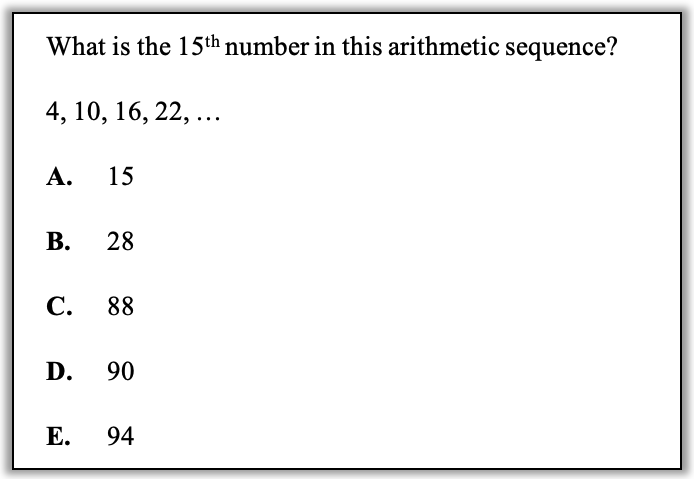

How can you approach this question in a way that makes sense to you? What conceptual understandings or visual tools can you bring to bear? What mathematical concepts do students really need to be able to tackle this problem? How might your real-world experience help you reason about this? How can this problem be approached concretely? Representationally? Abstractly?
Here are some possible approaches:
1. A concrete approach: Model it with tiles or counters. Admittedly, in a test situation students will not have counters nor the time to model with them, but I want to take the time to look at this approach anyway because it is valuable for building understanding. If a student in your class is struggling to make sense of this task, a concrete approach can make it accessible to them. Here’s how I modeled the sequence in this task using something I had at home and that students who are learning remotely are likely to have in their homes (or something like it).
This picture of my model doesn’t really tell the whole story of how it helps me make sense of the task. Here’s the story of how I made it: first, I counted out 4 Cheerios for the first column. For the second column, I counted out 10. Already, it had started to feel onerous to be counting them out one at a time, so for the third column, I lined up Cheerios with the second column and then counted up from 10 until I got to 16. For the fourth column, I did the same thing. I lined up 16 Cheerios with the third column without counting and then counted up from there to get to 22.
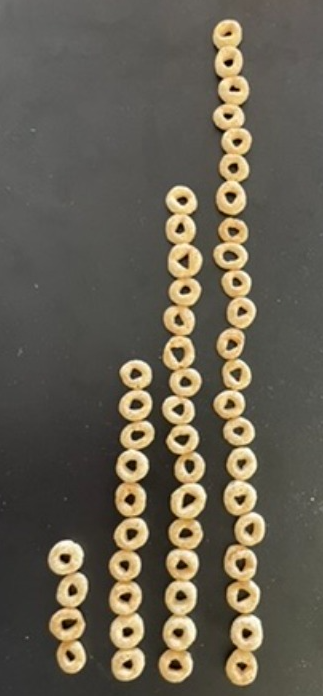
By this time, I had experienced what it feels like to go from one number to the next in the sequence. Each time, I counted up by 6 after lining up the Cheerios. Had I continued in this way, it would have taken me a long time to get to 15 terms (and I may have run out of space or Cheerios)! However, this concrete approach may have helped me understand well enough to continue on paper and start either drawing pictures of my Cheerios (more representational) or writing numbers (more abstract). I could draw rows or columns of shapes for a similar but slightly less tactile experience. Or maybe I will need to lay out some more columns of Cheerios to build my understanding. (An added benefit of this particular model is that it is edible. 😊)
One of the great things about concrete models is that as soon as we don’t need them anymore, they start to feel cumbersome, so you never have to tell a student it’s time to stop using manipulatives. They will move to paper or mental math as the manipulatives start to live in their brains.
Two representational approaches
2. Draw the sequence on a number line. This task is about how numbers are changing, and number lines are a good tool for helping us see the relationship between numbers. Here’s a number line that goes a little past 22, the highest given number, and shows the relationship between the numbers in the sequence.
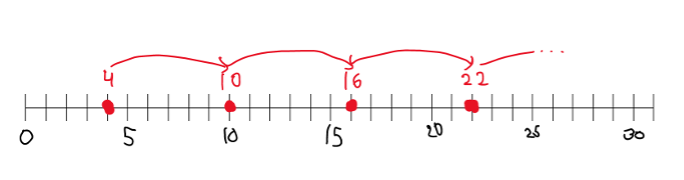
What insight might this number line give a student about how to proceed? What understandings might they gain from the process of drawing the number line? Can you think of other ways to illustrate this sequence?
While both this approach and the previous one feel like they could take a long time to get to the 15th term, they do actually give some idea of how the numbers are growing and what might be reasonable. Look back at the answer choices. Are there any that a student could eliminate using these models?
3. Draw the hops. Here’s an approach that is also representational but getting a little more abstract. Instead of drawing the hops on a number line, a student might draw them on the numbers themselves, possibly like this:
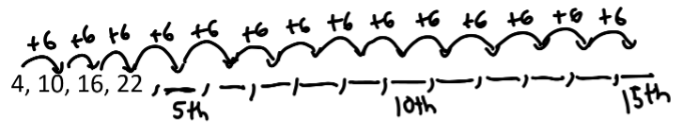
Given this illustration, how many ways can you think of to figure out what number goes in that last blank?
Two abstract approaches
4. Reason about and extend the change. Thinking about this task abstractly might involve recognizing that each number in the sequence can be arrived at by adding 6, so you can find the fifteenth number by adding a bunch of 6’s to the fourth number. But how many? I find that with things like this I’m never sure whether I should subtract 4 from 15 or whether it’s actually one more or one less than that, so I’d bring in a concrete tool and count up on my fingers to make sure I add the right number of 6’s. As I count on my fingers, I think, “fifth, sixth, seventh,…” When I know how many 6’s to add, I can use multiplication to figure out the number I have to add to 22 to get the fifteenth term.
5. Reason about a related sequence. Another abstract strategy is to connect this sequence to a related sequence that is easier to reason about. In the problem, the sequence increases by 6 each time. Another sequence that goes up by 6 each time is 6, 12, 18, 24, 30 … The special thing about this second sequence is that it is the multiples of 6. The third number is 3 × 6. The fifth number is 5 × 6. The fifteenth number will be 15 × 6. Look at the two sequences together. What do you notice that might help you figure out the fifteenth number in the original sequence?
Original sequence: 4, 10, 16, 22, …
Multiples of 6: 6, 12, 18, 24, …
Concrete, representational, and abstract are three ways of thinking about ideas. As we become more comfortable with ideas, our thinking about them tends to get more abstract. However, this doesn’t mean that abstract thinking is our goal. The goal is always to understand and to make sense—in whatever way works for you. Textbooks, tests, and our own history with math teaching and learning can push us toward thinking that abstract thinking is better and that we should be pushing students in that direction or worse, that we should be starting there and not spending time on concrete and representational approaches. It’s ineffective to start with abstract approaches because our brains are generally not ready to think abstractly about ideas that are new or challenging to us. In fact, if you start looking for it, you might start to see where you use concrete and representational approaches in your own life to help you make sense. Do you write out your schedule for the week to help with time management? Do you ask a person giving directions to sketch a map for you? Do you use gestures to illustrate what you’re trying to say? All of these things are using concrete and representational approaches to make abstract ideas more accessible.
In my math journey, I’ve learned the value of representational and abstract models and that gives me a powerful tool for my own learning. When I struggle, I ask myself how I can make the work more concrete. (Pictures are more concrete than symbols, and objects are more concrete than pictures.) As a teacher, I’ve found that providing supports that help students make the work more concrete is almost always effective in getting them unstuck. And I hope my students will learn to do that for themselves—reach for paper or tiles or Cheerios when they struggle to get a handle on a tough concept in math or other situations in their lives.

Aren Lew has worked in the field of adult numeracy for over ten years, both as a classroom teacher and providing professional development for math and numeracy teachers. They are a consultant for the SABES Mathematics and Adult Numeracy Curriculum & Instruction PD Team at TERC where they develop and facilitate trainings and workshops and coach numeracy teachers. They are the treasurer for the Adult Numeracy Network.